
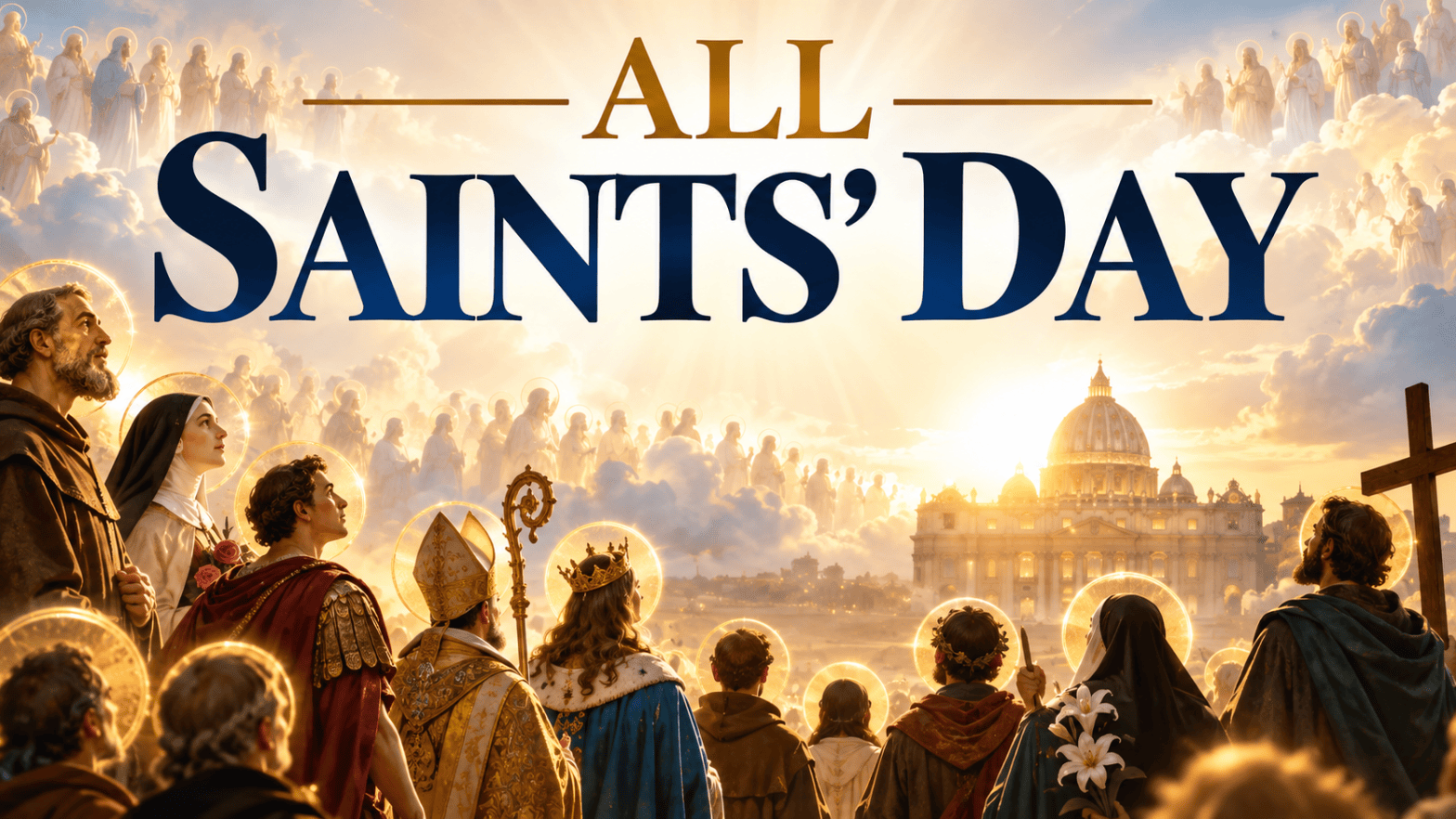
Discover the meaning, history, and traditions of All Saints’ Day, and learn how this beautiful Catholic solemnity points us toward Jesus Christ and our heavenly home.
Every year on November 1, the Catholic Church celebrates All Saints’ Day, a solemnity honoring all the saints in Heaven. From the apostles and martyrs of the early Church to holy men and women whose names are known only to God, this special day celebrates the countless faithful who now rejoice in His presence.
All Saints’ Day is more than a time to remember remarkable Christians from the past. It is a celebration of God’s grace, the victory of Jesus Christ over sin and death, and the promise of eternal life. The saints remind us that holiness is possible and that every Christian is called to grow in faith, love, and virtue.
Their lives also encourage us to look beyond the distractions of this world and remember our ultimate destination: eternal communion with God.
So what exactly is All Saints’ Day, why does the Catholic Church celebrate it, and how can we make this feast meaningful in our own lives?
What Is All Saints’ Day?
All Saints’ Day is a solemnity in the Catholic Church celebrated annually on November 1. It honors all those who have attained the glory of Heaven, including saints officially canonized by the Church and holy people whose names are known only to God.
When we think of saints, we might immediately remember familiar figures such as St. Peter, St. Paul, St. Augustine, St. Francis of Assisi, or St. Thérèse of Lisieux. Their lives have inspired Christians for generations, offering examples of courage, charity, sacrifice, and devotion to God.
However, All Saints’ Day is not limited to these well-known figures.
Throughout history, countless Christians have lived faithful lives without receiving widespread recognition. They may have served their families, cared for the poor, endured suffering with patience, or quietly helped others come to know Christ. Their names may never appear in a history book, but their faithfulness matters to God.
This is one of the most beautiful aspects of All Saints’ Day: we celebrate not only the saints we know by name, but also the countless holy men and women who now share in the joy of Heaven.
The solemnity reminds us that holiness is not reserved for a select few. God calls every Christian to pursue holiness, regardless of their background, occupation, personality, or circumstances.
What Does the Bible Say About All Saints’ Day?
Although the Bible does not explicitly command Christians to celebrate a feast on November 1, the central themes of All Saints’ Day are deeply rooted in Scripture.
The Bible speaks repeatedly about holiness, faithfulness, perseverance, and the hope of eternal life with God.
In 1 Peter 1:15–16, we read:
but as he who called you is holy, you also be holy in all your conduct, since it is written, “You shall be holy, for I am holy.” (1 Peter 1:15–16, ESV)
These words remind us that holiness is not merely an admirable quality possessed by a few extraordinary Christians. It is part of God’s calling for all His people.
Holiness means growing in love for God, turning away from sin, practicing virtue, and allowing His grace to transform our lives. Although we will continue to struggle with weakness and temptation, we are called to keep returning to God and seeking to follow Him faithfully.
The saints provide examples of what this journey can look like.
Another beautiful passage appears in Revelation 7:9, where St. John describes a vision of Heaven:
After this I looked, and behold, a great multitude that no one could number, from every nation, from all tribes and peoples and languages, standing before the throne and before the Lamb, clothed in white robes, with palm branches in their hands, (Revelation 7:9, ESV)
This vision offers a glimpse of the heavenly assembly gathered before God and Jesus Christ, the Lamb. The multitude comes from every nation and people, revealing the universal scope of God’s saving work.
All Saints’ Day celebrates this heavenly reality and reminds us that the Church’s story extends far beyond what we can see here on earth.
Hebrews 12:1 also encourages Christians to persevere:
Therefore, since we are surrounded by so great a cloud of witnesses, let us also lay aside every weight, and sin which clings so closely, and let us run with endurance the race that is set before us, (Hebrews 12:1, ESV)
The preceding chapter recounts the faith of many figures from the Old Testament. Their examples encourage us to remain faithful amid our own struggles.
The message is simple: we are not the first people to walk the path of faith, and we should not lose heart when following Christ becomes difficult.
Why Do Catholics Honor the Saints?
Catholics honor the saints because their lives demonstrate what God’s grace can accomplish in human beings.
The saints were not all born with extraordinary virtue, nor did they all live without struggles. Many experienced weakness, uncertainty, suffering, and the need for conversion. What makes their stories so inspiring is the way they responded to God’s grace and sought to remain faithful to Him.
Consider St. Augustine of Hippo, whose conversion followed years of searching for truth. His life reminds us that God can transform hearts and draw people toward Himself.
St. Francis of Assisi embraced a life of simplicity and service to the poor, reminding us not to place worldly possessions above God.
St. Maximilian Kolbe gave his life to save another prisoner at Auschwitz during World War II, demonstrating extraordinary sacrificial love.
St. Thérèse of Lisieux emphasized the importance of doing ordinary things with great love, reminding us that holiness can be pursued through small acts of faithfulness.
These saints lived in different centuries and faced very different circumstances, yet their lives point toward the same truth: following Jesus Christ transforms the way we live.
Catholics do not worship the saints. Worship belongs to God alone. Instead, the Church honors the saints as faithful servants of God and examples of Christian discipleship.
Their lives direct our attention toward the One who made their holiness possible: Jesus Christ.
As St. Paul writes: Be imitators of me, as I am of Christ. (1 Corinthians 11:1, ESV)
The saints encourage us to imitate their virtues insofar as they imitate Christ. Their example should inspire us to pray more faithfully, love our neighbors more generously, forgive more readily, and trust God more deeply.
What Is the Communion of Saints?
All Saints’ Day also highlights an important Catholic teaching known as the communion of saints.
The communion of saints expresses the spiritual unity of those who belong to Christ. The Church is not simply a collection of Christians who happen to worship together during their earthly lives. Through Jesus Christ, believers are adopted and united in one spiritual family.
The saints in Heaven remain united to Christ and His Church. Their earthly lives have ended, but their communion with God has reached its fulfillment.
This teaching gives All Saints’ Day a deeply personal meaning. We remember that Christianity is not an isolated journey. We belong to a family of believers extending across generations and throughout the world.
We can learn from the faithful who came before us, support those walking beside us, and help those who will follow after us.
Catholics also ask the saints to intercede for them, meaning to pray to God on their behalf. This practice reflects the Church’s understanding that the faithful in Heaven remain united with Christians on earth. It does not replace Jesus Christ, whose unique mediation makes our reconciliation with God possible.
Ultimately, the communion of saints reminds us that Christ’s victory over death brings hope beyond the grave.
A Brief History of All Saints’ Day
The roots of All Saints’ Day extend into the early centuries of Christianity.
Early Christian communities remembered martyrs who had died for their faith, particularly those who refused to deny Christ even under persecution. Their witness became a powerful example of Christian courage and hope in the resurrection.
Christians commemorated these martyrs and gave thanks to God for their faithful witness. Over time, local churches developed different celebrations honoring martyrs and other saints.
As the number of commemorations grew, broader celebrations honoring all the saints became increasingly important.
In the early seventh century, Pope Boniface IV dedicated the Pantheon in Rome as a Christian church honoring the Virgin Mary and the martyrs. Later, during the eighth century, Pope Gregory III established a celebration honoring all the saints at a chapel in St. Peter’s Basilica in Rome, associated with November 1.
The observance subsequently spread more widely throughout the Western Church, and November 1 became established as the date for the celebration.
Although the feast developed over time, its central purpose remained consistent: to honor the saints, celebrate God’s work in their lives, and encourage Christians to follow their example.
The history of All Saints’ Day reminds us that Christians throughout the centuries have looked to the faithful who came before them for inspiration and encouragement.
All Saints’ Day and All Souls’ Day: What Is the Difference?
All Saints’ Day is followed by another important observance in the Catholic calendar: All Souls’ Day, celebrated on November 2.
Although these celebrations are closely connected, they have different emphases.
All Saints’ Day celebrates those who have attained the glory of Heaven. It is a joyful celebration of the saints and the fulfillment of their journey toward God.
All Souls’ Day focuses on prayer for the faithful departed, especially those who are undergoing purification before entering the fullness of heavenly glory.
Catholic teaching holds that those who die in God’s grace and friendship but are not yet perfectly purified undergo purification, traditionally called purgatory, before entering Heaven. This is not a second chance at salvation, but the final purification of those who die in God’s grace.
On All Souls’ Day, Catholics especially remember deceased family members, friends, and others who have died. They pray for the departed and entrust them to God’s mercy.
Together, these two days encourage us to reflect on death, eternal life, and our hope in the resurrection of Jesus Christ.
They also remind us to live with eternity in mind, recognizing that our earthly lives are an opportunity to grow in love for God and our neighbors.
How Can We Celebrate All Saints’ Day?
There are several meaningful ways to observe All Saints’ Day and carry its message into our everyday lives.
- Attend Mass. All Saints’ Day is a holy day of obligation in the United States, subject to applicable exceptions and dispensations. Participating in the liturgy is a fitting way to honor God and celebrate the saints.
- Read about a saint. Choose a saint whose life interests you and learn about their journey of faith. Reflect on the virtues you can practice in your own life.
- Spend time in Scripture. Read Hebrews 11–12, Revelation 7:9–17, or Matthew 5:1–12. Consider what these passages teach about faith, holiness, and eternal life.
- Pray. Give thanks to God for the faithful witnesses who came before us.
- Practice a virtue. Choose one area in which you want to grow, such as patience, generosity, humility, or forgiveness.
- Share the faith with your family. Tell children or loved ones about the lives of the saints and discuss how their examples can help you follow Jesus more faithfully.
These practices do not need to be complicated. Even a few minutes spent in prayer, Scripture, or reflection can help us enter more deeply into the spirit of the feast.
Keeping Our Eyes on Heaven
All Saints’ Day is a beautiful reminder of the hope at the heart of Christianity.
The saints show us that a life devoted to Jesus Christ is worth living. Their stories remind us that holiness is possible through God’s grace and that our earthly struggles do not have the final word.
As we celebrate this solemnity, we can thank God for the faithful men and women who have gone before us, learn from their examples, and renew our commitment to following Christ.
May the celebration of All Saints’ Day strengthen our faith, deepen our love for Jesus, and remind us of the eternal joy for which God created us.
May we follow the example of the saints, remain faithful to Christ throughout our earthly journey, and one day share in the glory of Heaven with all God’s people.

Click the Image to
Get Your FREE Christian Apologetic Starter Pack
Study the Bible Deeper
• If you’re serious about growing in your understanding of Scripture, I highly encourage you to try Logos Bible Software—you can start with a free trial and see how it transforms your study time. — FREE TRIAL
• And for solid, biblically sound books and resources, take a look at ChristianBook.com—a great place to build your library. — CLICK HERE
Discover more from Mathetes Mission
Subscribe to get the latest posts sent to your email.


