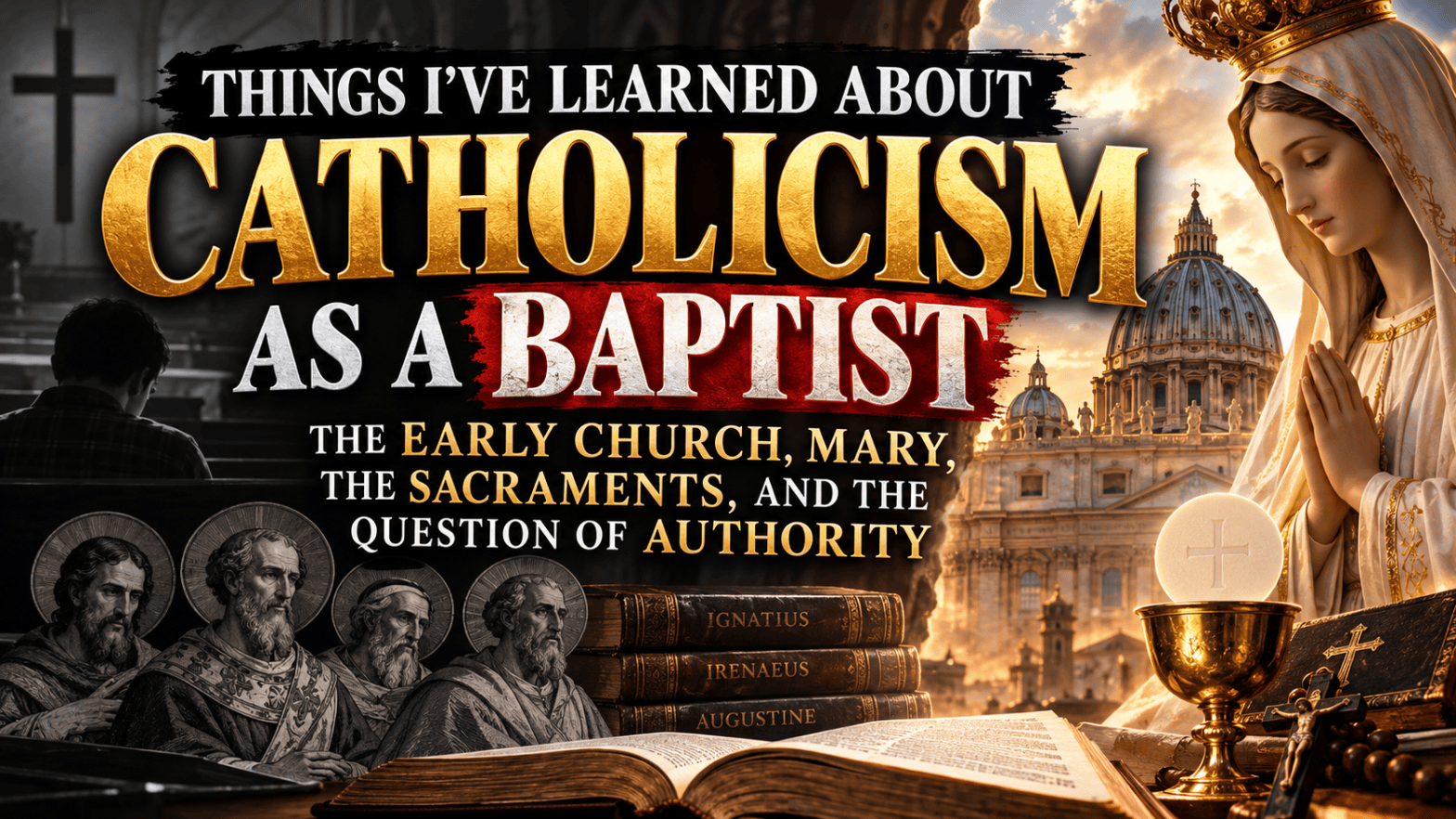
An honest Protestant reflection on church history, Catholic doctrine, and what happens when we take the beliefs of the early Christians seriously.
When Church History Challenges Your Assumptions
As a Baptist, I was taught to take the Bible seriously, defend the gospel, and measure Christian teaching against the Word of God. Those convictions remain important to me. Scripture is not something Christians should casually set aside, and the gospel of Jesus Christ must remain at the center of everything we believe.
But the more I have studied Catholicism, the early Church Fathers, and the history of Christian doctrine, the more I have realized that some of the things Protestants commonly say about Catholicism deserve a closer examination.
Some Catholic doctrines are not what Protestant critics assume they are. Certain beliefs that initially seem foreign become more understandable when examined in their historical and theological context. Other doctrines raise difficult questions that cannot be answered simply by quoting a Bible verse or pointing to a Reformation-era confession.
Perhaps most importantly, studying the early Church has forced me to confront a question that extends far beyond the Catholic-Protestant debate:
How do we determine who has the authority to interpret Christianity correctly, especially when Christians who sincerely believe in the authority of Scripture disagree with one another?
Christianity did not begin with the Protestant Reformation. It began with Jesus Christ, His apostles, and the Church they established. The New Testament emerged within that historical community, and the generations that followed preserved, copied, read, taught, and defended the apostolic faith.
Understanding that history does not automatically prove every Catholic doctrine. It does, however, challenge us to approach the subject with intellectual honesty, humility, and a willingness to reconsider assumptions.
Here are some of the most important things I have learned about Catholicism as a Baptist.
1. The Early Church Does Not Look Exactly Like Modern Protestantism
One of the first things that stands out when reading the early Church Fathers is how different their theological vocabulary and ecclesiastical practices can be from those of many modern evangelical and Baptist churches.
Consider Ignatius of Antioch, an early Christian bishop whose letters are generally dated to the beginning of the second century, around AD 107–110.
In his Letter to the Smyrnaeans, chapter 8, Ignatius connects the celebration of the Eucharist with the authority of the bishop. He emphasizes the importance of Christian unity and warns against treating the Eucharist as something ordinary. In chapter 7, he criticizes those who refuse to acknowledge the Eucharist as the flesh of Jesus Christ.
Think about that for a moment.
Ignatius was not writing during the medieval period, after centuries of Catholic theological development. He was writing near the beginning of the second century, when Christians were still much closer to the apostolic age.
His writings describe a Church with visible leadership, sacramental practices, and a strong concern for preserving Christian unity.
That picture does not necessarily align neatly with every modern Protestant understanding of the Church.
This does not mean Ignatius taught every doctrine that the Catholic Church would later formally define. We must distinguish between early Christian beliefs and later theological formulations. Nevertheless, his writings demonstrate that we cannot simply assume the earliest Christians understood the Church exactly as many modern Baptists do.
Another important figure is Irenaeus of Lyons, writing around AD 180.
In Against Heresies, Book III, chapters 3–4, Irenaeus appeals to apostolic succession and the public teaching of churches historically connected to the apostles. He particularly discusses the Church of Rome when explaining how the apostolic faith can be distinguished from competing teachings.
Irenaeus was not treating Christian doctrine as an isolated individual’s interpretation of biblical texts. He appealed to Scripture, apostolic tradition, and the historical continuity of Christian communities.
That raises an important question:
If the apostles entrusted the Christian faith to the Church, what role should the historical Church play in helping us understand that faith?
Catholics answer by appealing to Scripture, Sacred Tradition, and the Church’s teaching authority. Protestants generally disagree with the Catholic understanding of that authority, particularly where it concerns infallibility and the binding force of later doctrinal definitions.
But whatever conclusion we reach, we should acknowledge that the early Church’s understanding of authority was more complex than the idea that every believer independently reads the Bible and determines doctrine without reference to an authoritative ecclesial tradition.
The early Church deserves to be heard on its own terms, not reconstructed to look like the denomination we already belong to.
2. We Cannot Treat the Church Fathers Like a Collection of Convenient Quotes
This is one of the most important lessons I have learned from studying Christian history.
In theological debates, it is common to see a Protestant quote an early Church Father because one sentence appears to support a Protestant position. Catholics can do the same thing when they quote a Father whose language seems to support a Catholic doctrine.
The problem is not quoting the Fathers. The problem is treating them as authorities only when they agree with us.
Imagine someone quotes Augustine to support a particular understanding of grace but dismisses Augustine’s sacramental theology because it conflicts with their own tradition.
Or imagine someone appeals to an early Christian writer’s statement about the authority of Scripture but ignores that same writer’s understanding of bishops, baptism, the Eucharist, or ecclesial unity.
That is not a consistent historical method.
To be fair, neither Catholics nor Protestants must agree with every statement made by every Church Father. The Fathers sometimes disagreed with one another, used imprecise terminology, and developed their understanding of particular questions over time. Their writings do not constitute a single, perfectly uniform body of teaching, and they are not collectively infallible.
Nevertheless, when we appeal to a particular Father, intellectual honesty requires us to consider the broader context of his writings.
We should ask:
- What did this author believe about the broader subject?
- What was he responding to?
- How did he understand the Church, Scripture, and apostolic tradition?
- Does the quotation represent his broader position, or is it an isolated statement?
- How does his testimony compare with other Christian writers from the same period?
- Are we interpreting his words according to their original historical context, or imposing our modern theological categories upon them?
Consider Irenaeus again. His appeal to apostolic succession and the public tradition of the ancient churches is difficult to reconcile with a simplistic picture of early Christianity in which ecclesial authority was largely irrelevant.
A Protestant may respond that Irenaeus was mistaken about certain matters, that apostolic succession does not necessarily entail Roman Catholic claims, or that his statements must be understood in light of Scripture. Those are arguments worth examining.
But quoting Irenaeus when he appears to support one Protestant doctrine while ignoring his broader ecclesiology does not adequately address the historical evidence.
The same standard must apply to Catholics. Finding an early Christian statement that resembles a later Catholic doctrine does not automatically establish that the Father understood that doctrine in precisely the same way the Catholic Church defines it today.
Historical evidence should challenge our theology before we use our theology to filter out historical evidence.
The goal should not be to find a Church Father who sounds like a Baptist, Presbyterian, Anglican, or Catholic in one isolated sentence. The goal should be to understand what the early Church actually believed, how those beliefs developed, and what that history means for our understanding of apostolic Christianity.
If we are going to appeal to the early Church Fathers, we need to be willing to hear what they actually say, even when their broader theology makes us uncomfortable.
3. Sola Scriptura Raises a Serious Question About Authority
The Protestant principle of sola scriptura is often misunderstood, so it is important to define it accurately.
Classical Protestantism does not teach that Christians should ignore church history, reject every tradition, or assume that every individual’s interpretation of Scripture is correct.
Rather, sola scriptura teaches that Scripture alone is the ultimate infallible rule of faith, while other authorities—including pastors, creeds, confessions, and church councils—remain subordinate to Scripture.
That is a more sophisticated claim than simply saying, “I believe the Bible, not tradition.”
Nevertheless, I believe the principle raises a serious question about how authority functions in practice.
Suppose two Christians both affirm that Scripture is the ultimate authority. One is Baptist, and the other is Catholic. Both read the Bible, pray, study Christian history, and sincerely believe their conclusions are faithful to God’s revelation.
Yet they disagree about baptism, the Eucharist, the Church’s authority, the papacy, Mary, and the relationship between faith and works.
Both cannot be correct in every respect where their claims directly contradict one another.
Who settles the dispute?
A Protestant may appeal to the plain meaning of Scripture, the grammatical-historical method, the testimony of the early Church, or the conclusions of a particular theologian. A Catholic may appeal to Scripture as interpreted within Sacred Tradition and the Church’s living teaching authority.
But the Protestant must still determine which interpretation of Scripture is correct, which historical sources deserve weight, and which traditions accurately reflect apostolic teaching.
That process inevitably involves judgment.
If a Protestant accepts an early Church Father’s interpretation when it agrees with his theology but rejects that Father’s other teachings when they conflict with his theology, what ultimately determines which portions of the Father’s testimony are reliable? Is it just up to each individual believer’s interpretation at that point?
The answer cannot simply be, “Because Scripture is authoritative.” Both Christians already agree that Scripture is authoritative. The disagreement concerns what Scripture means, how its teachings fit together, and whether Christ established an authoritative Church to preserve and definitively interpret apostolic revelation.
This is where the historical question becomes particularly important.
Jesus did not leave behind a written book personally authored by Him. He commissioned apostles to teach, preach, baptize, make disciples, and establish communities of believers. Those apostles taught both orally and in writing.
Paul explicitly instructs the Thessalonians to hold fast to the traditions they were taught, whether by word of mouth or by letter (2 Thessalonians 2:15). He also tells Timothy to entrust what he has heard to faithful people who will teach others (2 Timothy 2:2).
Protestants interpret these passages in ways that preserve Scripture as the sole infallible rule of faith. Catholics understand them as evidence that apostolic revelation was transmitted through both written Scripture and Sacred Tradition.
These passages alone do not settle the entire debate. However, they demonstrate that the New Testament presents apostolic teaching as something transmitted through more than one medium.
There is another historical consideration: the New Testament canon was recognized through the life of the early Church. Christians did not receive a bound New Testament with a table of contents directly from Jesus. The books were written, circulated, read in Christian communities, and gradually recognized across the Church, with important milestones in the fourth century and continuing disputes about certain books along the way.
This does not mean the Church created the authority of the biblical books. Catholics and Protestants can agree that a book’s divine authority does not depend on a later institution granting it that authority.
The historical question is how Christians identify the inspired canon and why their judgments about it should be trusted.
The Catholic argument is that Christ established a Church with a continuing teaching office, guided by the Holy Spirit, to preserve and authoritatively interpret the apostolic deposit of faith. The Protestant response is that the Church recognizes Scripture’s authority but does not possess an infallible authority equal to Scripture in defining doctrine.
That disagreement is substantial. It cannot be resolved by pretending that one side has interpretation-free access to the Bible while the other relies on interpretation.
Every Christian must interpret texts. The question is whether Christ also established a visible, authoritative means of resolving certain disputes about that interpretation.
This is one of the most challenging issues in the Catholic-Protestant conversation. If sincere Christians can disagree about major doctrines while claiming the same ultimate authority, we must seriously consider whether the question of authority has been adequately answered.
This is not a claim that Protestantism has no answer. It is a recognition that sola scriptura must explain not only why Scripture is supreme, but also how the Church should identify sound interpretations when disagreements persist.
Personal conviction, however sincere, is not the same thing as an objective resolution of a theological dispute.
4. Marian Doctrine Is Often Misrepresented in Protestant Criticism
For many Protestants, Marian doctrine is one of the most difficult aspects of Catholicism to understand or accept. As a Baptist, I understand why.
We rightly emphasize that Jesus Christ is our Savior, that He is the one mediator between God and humanity, and that salvation is found in Him rather than in any other person.
When Catholics speak about Mary’s intercession, her perpetual virginity, the Immaculate Conception, or her Assumption into heaven, these teachings can initially seem to detract from Christ’s unique position.
But one of the things I have learned is that we should distinguish what the Catholic Church actually teaches from what its critics assume those teachings mean.
The Difference Between Worship and Veneration
Catholic theology distinguishes between latria, the adoration owed to God alone, and dulia, the veneration given to the saints. The special veneration traditionally given to Mary is called hyperdulia (The highest form of veneration reserved specifically for the Blessed Virgin Mary as the Mother of God—Theotokos)
Catholics do not formally teach that Mary is a goddess, that she is equal to the Trinity, or that she is an alternative savior.
The Catechism of the Catholic Church explicitly distinguishes Marian devotion from the adoration owed to God. It also teaches that Mary’s influence on believers depends entirely upon Christ’s unique mediation and the merits of His redemption.
Whether every popular expression of Marian devotion communicates those distinctions clearly is another question. Individual Catholics can express themselves carelessly, and particular devotional practices deserve scrutiny when necessary.
But it is inaccurate to present the official Catholic position as though it simply places Mary on the same level as God.
This distinction matters because a fair critique must address the actual doctrine rather than a caricature of it.
Mary as the New Eve
One of the most interesting discoveries in early Christian theology is the connection between Mary and Eve.
In Against Heresies, Book III, chapter 22, Irenaeus of Lyons develops a parallel between Eve’s disobedience and Mary’s obedience. Eve, while still a virgin, disobeyed God’s command; Mary, also a virgin, responded obediently to God’s message and became the mother of Christ according to the flesh.
Irenaeus presents Mary’s obedience as part of the reversal of the disobedience associated with Eve. This is commonly called the New Eve theme.
The theological significance is not that Mary replaces Jesus as the Redeemer. Rather, it is that God’s saving plan unfolds through the obedience of human beings, ultimately fulfilled in the obedience and saving work of Christ.
The New Testament itself provides the foundation for this kind of typological reasoning. Paul contrasts Adam and Christ in Romans 5:12–21 and 1 Corinthians 15:21–22, 45–49. Irenaeus extends the pattern by comparing Eve and Mary.
This is an important example of early Christian theology developing connections between biblical events and persons to illuminate the unity of salvation history.
It also helps explain why Catholic theology views Mary’s role as significant without formally treating her as an independent source of salvation.
Mary as the Mother of God
Another doctrine frequently misunderstood is the title Theotokos, commonly translated “God-bearer” or “Mother of God.”
This title was formally affirmed at the Council of Ephesus in AD 431, although the theological concerns behind it predated the council.
The point was not that Mary existed before God, created the divine nature, or was the source of the Trinity. Rather, the title defended the unity of Christ’s person.
Jesus Christ is truly God and truly man. Mary gave birth to the incarnate Son, who is one divine person. Therefore, the Church affirmed that she is rightly called the Mother of God—not because she originated His divinity, but because the person she bore is God the Son incarnate.
This is fundamentally a Christological claim.
A Protestant can still debate whether the title is necessary, how it should be used, or what further doctrines can legitimately be derived from it. But dismissing the title as though Catholics believe Mary created God misses the historical and theological point.
Before rejecting a doctrine, we should understand the question it was intended to answer.
The Immaculate Conception Is Not the Virgin Birth
These doctrines are frequently confused.
The virgin birth concerns Jesus Christ’s conception without a human father. The Immaculate Conception concerns Mary’s own conception: Catholic doctrine teaches that, by a unique grace of God and in view of the merits of Jesus Christ, Mary was preserved from original sin from the first moment of her existence.
This doctrine was formally defined by Pope Pius IX in 1854. Its formal definition came much later than the writings of the earliest Church Fathers, and the historical development of the doctrine is a legitimate subject of theological debate.
A Protestant may argue that the doctrine lacks sufficient biblical support or that its development cannot be justified by apostolic revelation. Catholics argue that it is a legitimate development of the faith preserved by the Church.
The historical evidence should not be overstated. The fact that early Christians praised Mary’s holiness does not, by itself, prove that they held the fully developed doctrine of the Immaculate Conception.
But neither should the doctrine be dismissed without examining the theological reasoning Catholics actually offer for it.
Do Catholics Worship Mary?
The short answer, according to official Catholic teaching, is no.
Catholicism distinguishes worship, which belongs to God alone, from veneration, which can be given to saints. Catholics ask Mary and other saints to intercede for them, understanding this as a request for the prayers of members of Christ’s body who are alive in Him.
Protestants commonly object that Scripture does not clearly authorize invoking departed saints and that prayer should be directed to God through Christ. That is a genuine theological disagreement, not one that disappears simply because we clarify Catholic terminology.
The Catholic position is not that Mary competes with Christ’s mediation. It is that the unique mediation of Christ can include the prayers and cooperation of His people without diminishing His role as the sole Redeemer.
The Protestant objection is often that the practice itself lacks adequate biblical warrant, risks obscuring Christ’s sufficiency, or depends upon theological assumptions about the communion of saints that Protestants do not accept.
Those are arguments worth engaging directly.
Catholic teaching on Mary is also not a license for exaggerated or superstitious devotion. In Lumen gentium §67, the Second Vatican Council explicitly cautioned against exaggerations in Marian devotion and emphasized that authentic devotion must remain properly ordered toward Christ.
That is worth remembering. Catholics themselves acknowledge that Marian devotion can be expressed poorly and must remain oriented toward Christ.
The more I study this subject, the more I see that the best Protestant response is not to assume the worst about Catholic doctrine. It is to understand the doctrine accurately, examine its biblical and historical foundations, and then determine whether its claims are justified.
5. The Sacraments Were Central to Early Christianity
Another major discovery concerns the sacraments.
Many modern evangelicals and Baptists understand baptism primarily as an ordinance of obedience and public identification with Christ, and the Lord’s Supper primarily as a memorial of His death.
Baptist churches vary in their precise sacramental language, but they generally reject the Catholic understanding of seven sacraments as efficacious signs of grace instituted by Christ.
When we read early Christian sources, however, we encounter a sacramental worldview that is often more robust than what modern Christians may expect.
This does not mean every early Christian held an identical theology of the sacraments. Nor does it mean that the complete medieval or modern Catholic sacramental system was already articulated in the second century.
We must distinguish early evidence from later doctrinal definitions.
Nevertheless, the evidence is substantial enough to challenge the idea that sacramental theology was simply invented centuries after the apostles.
The Eucharist in the Second Century
Ignatius of Antioch, writing in the early second century, speaks about the Eucharist in remarkably strong terms.
In Letter to the Smyrnaeans 7, he criticizes those who refuse to confess that the Eucharist is the flesh of Jesus Christ, who suffered for sins and was raised by the Father.
That is more than a casual description of a symbolic remembrance. Ignatius connects the Eucharist directly to the reality of Christ’s incarnate flesh.
Around the middle of the second century, Justin Martyr describes Christian worship in his First Apology, chapters 65–67. He explains that Christians do not receive the Eucharistic elements as ordinary bread and drink, but in relation to the flesh and blood of the incarnate Jesus.
Justin’s explanation also connects Eucharistic participation with the Christian community’s faith and moral life. The sacrament is not an isolated ritual detached from the Church’s confession of Christ.
Later in the second century, Irenaeus discusses the Eucharist in Against Heresies, Book V, chapter 2. He argues that the bread and wine are connected with Christ’s body and blood and uses this reality in his argument for the goodness of God’s creation and the future resurrection of the body.
These writers do not employ every technical distinction used in later Catholic theology. They do, however, show that early Christians often spoke about the Eucharist in terms of a genuine participation in, or connection with, Christ’s body and blood.
A Protestant interpretation that reduces the earliest Eucharistic theology to a merely symbolic memorial must reckon with these sources.
At the same time, historical care is necessary. The Fathers’ language does not, by itself, establish every detail of later Catholic teaching concerning transubstantiation. That term and its formal theological definition belong to a later stage of doctrinal development.
The proper conclusion is that a strong, realist understanding of the Eucharist existed very early in Christian history. The precise relationship between that early belief and later Catholic definitions requires careful theological analysis.
Baptism in the Second and Third Centuries
Baptism was also treated as a serious theological event, not merely as a public statement of personal conviction.
The New Testament itself associates baptism with repentance, forgiveness, union with Christ, and new life. Consider Acts 2:38, Romans 6:3–4, Galatians 3:27, and 1 Peter 3:21.
Christians disagree about how these passages relate to justification, regeneration, and the role of faith, but the language is undeniably significant.
Justin Martyr, in First Apology 61, describes Christian baptism in connection with regeneration and the forgiveness of sins. His account presents baptism as part of conversion and entrance into the Christian community, not simply as a later public ceremony for someone whose salvation is already entirely unrelated to the rite.
Around the beginning of the third century, Tertullian wrote On Baptism, a work devoted to the significance and practice of the sacrament. He discusses baptism in connection with the forgiveness of sins, spiritual renewal, and the Christian life. Tertullian also famously gave the earliest historical mention of infant baptism, where he cautioned against it, asking why innocent children should rush to have their sins washed away. So he cautioned against infant baptism, while affirming baptism itself has more meaning than just something symbolic.
In the third century, Cyprian of Carthage also wrote extensively about baptism, church unity, and the conditions under which baptism was recognized. His writings demonstrate that baptism was bound up with serious questions of ecclesial authority and Christian identity.
These sources do not eliminate every Protestant argument about baptism. A Baptist can still argue that baptism should follow a personal profession of faith, that infants should not be baptized, or that the rite does not cause regeneration in the Catholic sense.
But the historical evidence should make us cautious about assuming that the earliest Christians generally understood baptism in precisely the same way that modern evangelical churches often do.
The question is not whether every early Christian was a Roman Catholic in the modern sense. The question is whether the early Church’s sacramental beliefs provide evidence that should inform our theology today.
I believe they should.
What About the Seven Sacraments?
Catholicism recognizes seven sacraments: Baptism, Confirmation, the Eucharist, Penance, Anointing of the Sick, Holy Orders, and Matrimony.
It would be historically inaccurate to claim that every second-century Christian explicitly enumerated these seven rites as a single, formally defined list. The Church’s sacramental theology and terminology developed over time.
However, the underlying practices and many of the theological convictions associated with these sacraments have ancient roots.
Baptism and the Eucharist are clearly prominent in the earliest sources. The laying on of hands, reconciliation after serious sin, ordination, marriage, and prayer or anointing for the sick also have early Christian foundations, though the way these practices were categorized and understood developed over time.
This distinction between the historical existence of a practice and the later formal definition of a doctrine is essential.
A doctrine does not necessarily have to appear in its final technical vocabulary in the second century to have roots in apostolic Christianity. But neither can we assume that every later definition is automatically apostolic simply because a related practice existed early.
We must examine continuity, development, biblical grounding, and the historical testimony together.
For me, the sacramental evidence has made it difficult to dismiss Catholicism as though its entire understanding of the sacraments originated in the Middle Ages.
Early Christians took baptism, the Eucharist, and the Church’s sacramental life seriously. That fact deserves a serious response from Protestants.
6. Tradition Is Not Automatically the Enemy of Scripture
One unfortunate habit in Christian debate is treating the words Scripture and tradition as though they must always be enemies.
The Bible itself contains warnings against human traditions that contradict God’s commandments. Jesus condemns the misuse of tradition in Mark 7:6–13. Paul warns against deceptive philosophies and human traditions in Colossians 2:8.
Those passages matter. No Christian should defend a practice merely because it is old, popular, or associated with a religious institution.
But the New Testament also speaks positively about apostolic teaching transmitted orally. Paul instructs Christians to maintain the traditions they received from him (2 Thessalonians 2:15), and he commends the Corinthians for maintaining the traditions he delivered to them (1 Corinthians 11:2).
The critical distinction is between apostolic tradition and merely human traditions that contradict divine revelation.
Catholic theology argues that Sacred Tradition is not an independent source of new revelation competing with Scripture. Rather, Scripture and Sacred Tradition transmit the one apostolic deposit of faith, which the Church is charged with preserving and interpreting.
Protestant theology generally argues that apostolic tradition must be tested against Scripture, which alone is the final infallible standard.
Both sides must explain how the apostolic faith was transmitted and how it can be distinguished from later human innovations.
The early Church Fathers are important here because they lived much closer to the apostolic period than we do. Their testimony is not infallible, but it can provide valuable evidence about what Christians believed, practiced, and understood themselves to have received from the apostles.
If a doctrine appears consistently in early Christian writings, that does not automatically prove it is true. But it does create a historical question that should not be dismissed without investigation.
Likewise, if a doctrine appears only much later, we should investigate whether it represents a legitimate development of earlier teaching or a departure from it.
Historical theology requires more than asking whether we can find a verse that sounds supportive of our preferred conclusion. It requires examining the whole body of evidence.
7. Doctrinal Development Is Not the Same as Inventing New Doctrine
Catholics often appeal to the development of doctrine to explain why later definitions may be more precise than the language found in the earliest Christian writings.
The basic idea is that the Church can come to express an apostolic belief with greater precision over time, especially when controversies force Christians to clarify what they mean.
For example, the Council of Nicaea in AD 325 used the term homoousios to express the Son’s consubstantiality with the Father. That technical terminology was not simply quoted from a single New Testament verse, but it was intended to defend the Church’s understanding of what Scripture teaches about the identity of Christ.
The same general question arises with Marian doctrine, the sacraments, and the Church’s authority: can later definitions legitimately clarify truths already contained in apostolic revelation?
Catholics answer that the Church, guided by the Holy Spirit, can make authoritative doctrinal definitions that faithfully articulate the deposit of faith.
Protestants often respond that doctrinal development must be carefully distinguished from adding teachings that cannot be established from Scripture. Some Protestant traditions accept a degree of historical development while rejecting Catholic claims about the authority of particular definitions.
The important point is that neither side can avoid the question of development entirely. Even Protestants use theological terminology, creeds, confessions, and interpretive frameworks that help explain biblical teaching.
The existence of later terminology is not, by itself, proof of corruption. But historical continuity and theological coherence must be demonstrated rather than assumed.
A responsible examination asks whether a later doctrine faithfully clarifies apostolic teaching, whether it contradicts Scripture, and what evidence supports its claimed continuity with the early Church.
That approach is more demanding than simply declaring that everything old is correct or that everything unfamiliar must be a later corruption.
8. The Early Church Took Authority Seriously Long Before the Reformation
One of the most important historical questions is what the early Christians believed the Church was supposed to be.
Today, Christians often speak about the Church primarily as a collection of individual believers who share a common faith. That is certainly part of the biblical picture. But the New Testament also presents the Church as a visible community with recognized leaders, a shared confession, sacramental practices, and responsibilities to preserve sound teaching.
Paul calls the Church “the pillar and ground of the truth” in 1 Timothy 3:15 in the King James Version. Other translations render the phrase as “the pillar and foundation of the truth.” Whatever translation one prefers, the passage assigns the Church a significant role in relation to Christian truth.
Jesus also gives His disciples instructions about resolving disputes within the Church in Matthew 18:15–20. Paul addresses the authority and responsibilities of church leaders throughout his letters, and the Pastoral Epistles emphasize the importance of appointing qualified elders and preserving sound doctrine.
The question then becomes: if the Church is just an invisible structure that consists of the body of believers, who decides what is sound doctrine and where are people to turn when they have disagreements over their interpretations of Scripture? I believe this is the central cause for all the schism and division in the body of Christ in modern Christianity.
The early Fathers continued to take these matters seriously.
Ignatius of Antioch repeatedly emphasizes the unity of the local Church under its bishop. In his Letter to the Smyrnaeans, he connects the bishop’s oversight with the celebration of the Eucharist and the unity of the Christian community.
Irenaeus appeals to apostolic succession and the public teaching of ancient churches as safeguards against teachings that claimed secret or alternative origins.
These writings reveal that the question of authority was not invented by medieval Catholic theologians. Christians were already concerned with how to identify authentic apostolic teaching, preserve unity, and distinguish the faith received from the apostles from competing claims.
The difficult question is how far this early understanding of authority extends.
Catholics argue that it supports the continuing authority of bishops in apostolic succession and, ultimately, the distinctive role of the Bishop of Rome. Protestants may accept the importance of early bishops and historical continuity while denying that these facts establish the full Catholic claims about papal infallibility or universal jurisdiction.
That disagreement deserves a detailed examination of the historical evidence rather than a quick dismissal.
It is equally important not to collapse all forms of ecclesial authority into one category. The existence of bishops in the second century does not automatically prove every later Catholic claim about the papacy. Those claims require their own historical and theological arguments.
Nevertheless, the early Church challenges the assumption that Christian authority was always understood as a purely individual relationship between the believer and the biblical text.
The early Christians cared deeply about who was authorized to teach, how apostolic teaching was preserved, and how disputes should be resolved.
Those are still the questions we face today.
9. The Reformation Raises a Question About Historical Continuity
The Protestant Reformation was not a single event driven by one concern. It involved serious theological disputes about justification, ecclesial authority, indulgences, the sacraments, and the relationship between Scripture and tradition.
Many Reformers believed they were recovering the biblical and apostolic faith from teachings and practices that had developed improperly. Catholics, meanwhile, maintained that the Church possessed legitimate authority to preserve and interpret the faith and that the Reformers had rejected essential elements of that authority.
It would be simplistic to portray the Reformation as merely a rebellion against the Church. It would be equally simplistic to portray the medieval Church as entirely corrupt or to assume that every Protestant criticism was mistaken.
There were genuine theological and moral issues at stake.
But the historical question remains: how should Christians evaluate a movement that arose more than a millennium after the apostles and resulted in numerous competing ecclesial traditions?
A Protestant may argue that the Church had departed from biblical teaching and therefore required reform. From that perspective, fidelity to Scripture may require rejecting longstanding traditions.
A Catholic may respond that the Holy Spirit would not abandon Christ’s Church to such a degree that its essential teaching authority became untrustworthy for centuries, and that the Reformation’s divisions demonstrate the danger of separating doctrinal interpretation from the Church’s authoritative teaching office.
Both positions involve theological assumptions about Christ’s promises to His Church.
Matthew 16:18–19, Matthew 28:18–20, John 16:13, and John 17:20–23 are among the biblical passages that become central to these discussions. Catholics and Protestants interpret their implications differently.
The question cannot be settled merely by observing that Catholicism is older as an institutional tradition than any Protestant denomination. Antiquity alone does not establish truth. Nor can it be settled by asserting that a later reform movement must be correct simply because its adherents believe they have returned to Scripture.
Historical continuity matters, but it must be evaluated alongside biblical fidelity.
For a Baptist studying Catholicism, this means asking whether the Reformers correctly identified genuine errors, whether they interpreted Scripture faithfully, and whether their rejection of certain Catholic claims was justified by the historical evidence.
It also means asking whether the Catholic Church’s claims about continuity and authority withstand careful scrutiny.
Those are not questions we should be afraid to ask.
10. The Real Challenge Is Not Simply Catholicism Versus Protestantism
The deeper issue underlying many of these debates is the relationship between Scripture, history, tradition, and authority.
A Christian can acknowledge that early Christians believed things differently from many modern Protestants without automatically becoming Catholic. Likewise, a Catholic can recognize that some later Catholic doctrines require more historical explanation than others without abandoning the Catholic faith.
The goal is not to decide every issue in a single article. It is to understand what is actually at stake.
When studying a doctrine, I believe we should ask four questions.
First, what does Scripture teach?
We should examine the relevant passages in their literary, historical, and theological contexts. We should not rely on isolated verses while ignoring the wider biblical narrative.
Second, what did the earliest Christians believe?
We should read the primary sources rather than relying exclusively on modern summaries. The writings of Ignatius, Justin Martyr, Irenaeus, Tertullian, Cyprian, Athanasius, Augustine, and others provide invaluable evidence.
Third, how did the doctrine develop?
We should distinguish between an early belief, a developing theological explanation, and a later formal definition. These are related but not identical categories.
Fourth, who has the authority to resolve the disagreement?
This is perhaps the most difficult question of all. If Scripture is interpreted differently by sincere and informed Christians, what determines which interpretation is binding? Does Christ’s Church possess an authoritative teaching office capable of resolving certain disputes, or does the final determination remain with Scripture interpreted by the individual believer and the Church’s subordinate authorities?
The answer has enormous implications for how we understand Christianity.
It affects not only Catholic-Protestant disagreements but also disagreements among Baptists, Presbyterians, Lutherans, Anglicans, and other Protestant traditions.
The challenge is to explain how our understanding of Christian doctrine can remain accountable to the apostolic faith without reducing the question of authority to whichever interpreter we personally trust.
Conclusion: Humility Before Scripture and History
As a Baptist, studying Catholicism has taught me that I need to be careful about the assumptions I bring into theological discussions.
Some Catholic doctrines are more nuanced than Protestant criticisms sometimes suggest. Marian theology, in particular, must be understood through the Catholic distinction between Mary’s unique role in salvation history and the worship owed to God alone.
The early Church also took baptism, the Eucharist, ecclesial unity, and apostolic authority seriously. These beliefs did not suddenly appear in the Middle Ages, even though their theological explanations and formal definitions developed over time.
The Church Fathers cannot simply be recruited as convenient witnesses for whichever modern denomination we already support. Their writings must be read in context, and their broader theological convictions deserve consideration even when they challenge our assumptions.
Most importantly, I have learned that sola scriptura raises a question that every Protestant should be prepared to address: If Scripture is the ultimate authority, how do we determine which interpretation of Scripture is correct when faithful Christians disagree?
Saying that the Bible is authoritative does not, by itself, resolve disagreements about what the Bible teaches. Nor does appealing to the Church automatically settle every Catholic claim. Both sides must make their arguments from Scripture, history, and sound theological reasoning.
I do not believe intellectual honesty requires abandoning Protestant convictions whenever an early Christian writer disagrees with them. But it does require taking that disagreement seriously rather than dismissing the evidence simply because it is inconvenient.
Likewise, I do not believe that Catholic claims should be accepted merely because they appeal to ancient tradition. Antiquity is important evidence, but every doctrine must still be evaluated carefully.
What I do believe is that Christians should be willing to follow the evidence wherever it leads, even when it challenges the theological framework in which they were raised.
If we believe Christianity is true, then we have nothing to fear from honest historical investigation.
The truth does not become less true because we examine it more carefully.
And if we genuinely want to understand the faith delivered to the apostles, we should be willing to listen to the Christians who came before us—not merely when they agree with us, but especially when they force us to reconsider what we thought we knew.
The ultimate question is not whether Catholicism or Protestantism feels more familiar to us.
It is whether our beliefs faithfully reflect the teaching of Jesus Christ and the apostolic faith entrusted to His Church.
That is a question worth studying, praying over, and approaching with humility.
Further Reading: Primary Sources Worth Examining
For readers who want to investigate these questions directly rather than relying exclusively on modern Catholic or Protestant commentary, the following primary sources are an excellent starting point.
- Ignatius of Antioch — Letter to the Smyrnaeans. An early witness to Eucharistic belief, episcopal authority, and ecclesial unity.
- Justin Martyr — First Apology, chapters 61 and 65–67. An account of baptism and the Eucharist in the second-century Church.
- Irenaeus of Lyons — Against Heresies, Book III, chapters 3–4 and 22. Important discussions of apostolic succession, the public tradition of the Church, and Mary as the New Eve.
- Irenaeus of Lyons — Against Heresies, Book V, chapter 2. A discussion of the Eucharist and the resurrection of the body.
- Tertullian — On Baptism. A third-century treatment of baptism and its theological significance.
- Cyprian of Carthage — On the Unity of the Catholic Church. A significant early work on Church unity and ecclesial authority.
- Augustine of Hippo — On Christian Doctrine. A valuable work on interpreting Scripture, understanding signs, and the relationship between interpretation and Christian teaching.
- The Council of Nicaea (AD 325) and the Council of Ephesus (AD 431). Important sources for understanding the development of Christian teaching about Christ and the title Theotokos.
- The New Testament — especially Acts 2, Matthew 16 and 18, John 6 and 17, Romans 5–6, 1 Corinthians 10–11, 1 Timothy 3, and 2 Thessalonians 2. These passages are central to many of the disagreements discussed above.
Many of these early Christian texts are available free through the New Advent Church Fathers collection and the Christian Classics Ethereal Library.
Read the original writings alongside careful historical scholarship, and compare Catholic and Protestant interpretations rather than relying on only one perspective.

Click the Image to
Get Your FREE Christian Apologetic Starter Pack
Study the Bible Deeper
• If you’re serious about growing in your understanding of Scripture, I highly encourage you to try Logos Bible Software—you can start with a free trial and see how it transforms your study time. — FREE TRIAL
• And for solid, biblically sound books and resources, take a look at ChristianBook.com—a great place to build your library. — CLICK HERE
Discover more from Mathetes Mission
Subscribe to get the latest posts sent to your email.


