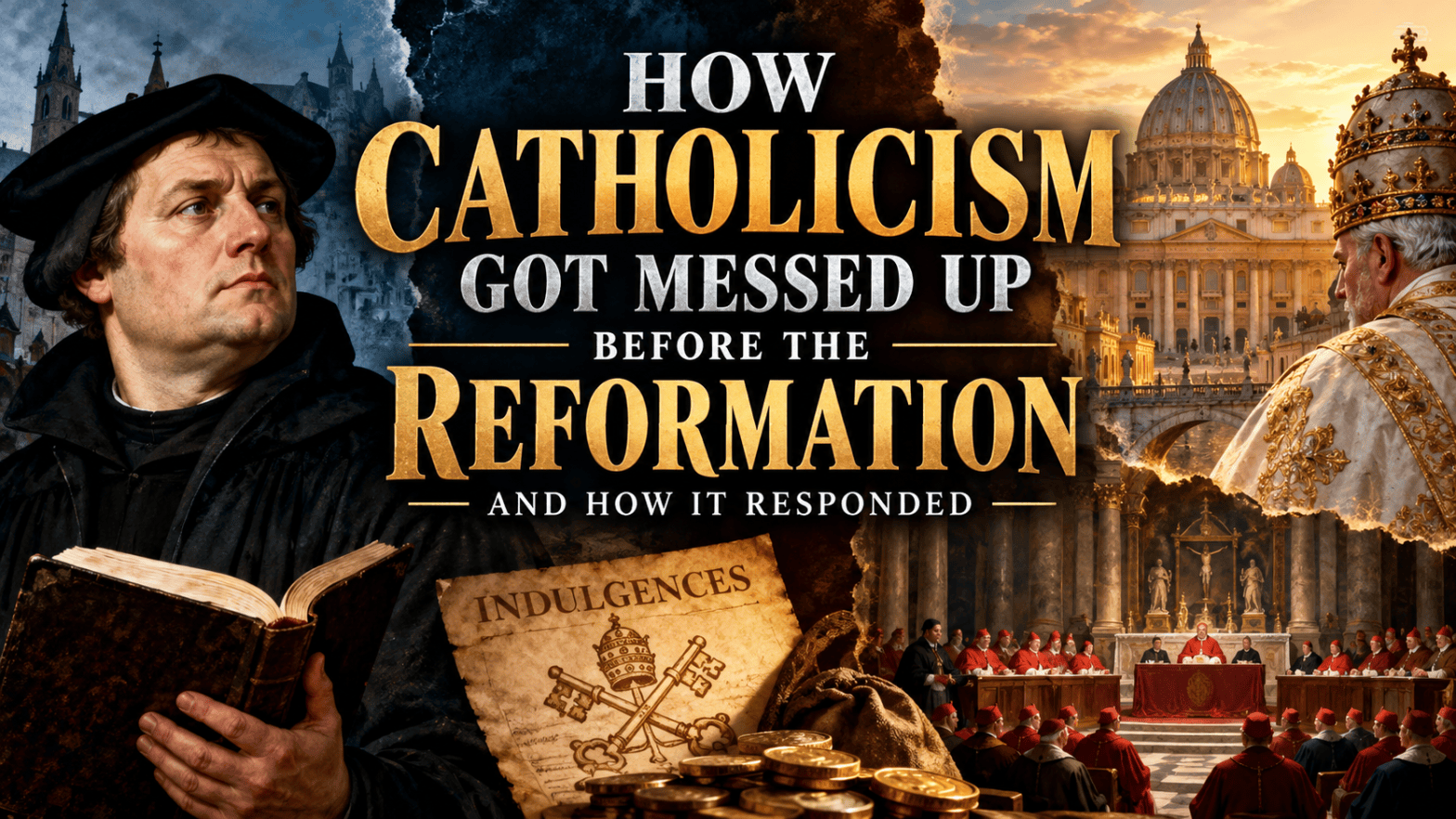
A historical examination of the abuses, theological disputes, and Catholic reforms that shaped the Protestant Reformation
The Protestant Reformation was one of the most consequential events in Christian history. Beginning in the early sixteenth century, it challenged the authority, practices, and teachings of the Western Catholic Church, eventually producing the Lutheran, Reformed, Anglican, and other Protestant traditions.
But what actually went wrong?
Was the Catholic Church corrupted by greed and political power? Did church leaders depart from biblical Christianity? Were the Reformers correcting abuses that Catholics themselves recognized, or did they introduce fundamentally different teachings about salvation and the Church?
And perhaps most importantly: Did the Catholic Church correct the problems that originally caused the Reformation, or did it simply become more disciplined while continuing to teach the same doctrines Protestants rejected?
To answer these questions fairly, we must distinguish between three things: corruption among church leaders, abuses of legitimate religious practices, and disagreements over Christian doctrine.
The historical evidence reveals that all three played a role. It also reveals something important: the Catholic Church undertook substantial reforms, but it did not accept the central theological conclusions of the Protestant Reformers.
1. The Problems Were Building Long Before Martin Luther
The Reformation did not begin because one monk suddenly decided Christianity needed to change. By the late Middle Ages, the Western Church faced serious institutional problems, including political interference, financial abuses, poorly educated clergy in some regions, and widespread dissatisfaction with church leadership.
These problems did not mean every priest, bishop, or pope was corrupt. Nor did they mean every Catholic teaching was invented during this period. Many Christians remained deeply devoted to Christ, and numerous religious communities pursued genuine spiritual renewal.
Nevertheless, the Church’s institutional problems had become difficult to ignore.
Political power and the papacy
During the medieval period, the papacy became a major religious and political institution. Popes sometimes negotiated with kings, influenced territorial disputes, exercised political authority, and participated in conflicts between European rulers.
The relationship between spiritual leadership and political power was complicated. Defenders believed the papacy had legitimate responsibilities in Christian society, while critics argued that church leaders had become too concerned with worldly influence.
The Avignon Papacy, from 1309 to 1377, intensified concerns about the papacy’s independence and credibility. During this period, popes resided in Avignon rather than Rome. Later, the Western Schism of 1378–1417 produced rival claimants to the papal office, each supported by different political factions.
Imagine ordinary Christians trying to understand how the Church could claim to provide unified spiritual leadership while competing popes claimed the same office.
These crises did not, by themselves, disprove Catholic claims about the papacy. They did, however, damage confidence in the institution and encouraged questions about the nature and limits of ecclesiastical authority.
Wealth, patronage, and corruption
Another problem involved the distribution of church offices and the financial interests surrounding them.
Some positions were obtained through political connections, family influence, or financial arrangements rather than spiritual qualifications. Practices such as simony—the buying and selling of ecclesiastical offices—had been condemned for centuries, yet remained a recurring concern.
Pluralism, in which one cleric held multiple church benefices, could also create problems. When combined with absenteeism, it meant that some officeholders received income from positions whose pastoral responsibilities they did not personally fulfill.
Some bishops and other senior churchmen lived as political elites, while local congregations sometimes lacked effective pastoral leadership.
These were not merely Protestant accusations invented after the fact. Church reformers had criticized clerical abuses long before Luther, and attempts at reform had repeatedly struggled against entrenched interests. The Council of Trent would later address problems involving episcopal residence, clerical discipline, and the appointment and formation of church leaders. 1
The central issue was not that wealth automatically made a person corrupt. It was that church offices could become instruments of personal advancement rather than service to Christ and his people.
2. Indulgences: The Controversy That Brought Luther Into the Spotlight
One of the most recognizable causes of the Reformation was the controversy surrounding indulgences.
To understand it, we must first distinguish Catholic teaching from the abuses associated with it.
In Catholic theology, an indulgence does not purchase God’s forgiveness or replace repentance. It concerns the remission of temporal punishment associated with sins whose guilt has already been forgiven. Catholic theology connects this practice to the Church’s authority to apply the spiritual benefits of Christ and the saints.
Protestants generally challenged the biblical foundations of this system, especially the idea that the Church could administer indulgences in the way Catholic theology maintained.
But in the early sixteenth century, the problem extended beyond the theological explanation.
How indulgences became controversial
Indulgences were associated with acts of devotion, penitential practices, charitable contributions, and other ecclesiastically authorized purposes. Over time, however, the relationship between indulgences and financial fundraising became a source of scandal.
A particularly controversial campaign was associated with Johann Tetzel, a Dominican preacher who promoted indulgences in German territories during the period surrounding Martin Luther’s protest in 1517.
The fundraising campaign was connected to the financing of St. Peter’s Basilica in Rome and to financial arrangements involving the Archbishop of Mainz and the Fugger banking family.
The details of indulgence preaching varied, and popular slogans or stories about the practice were sometimes exaggerated. Nevertheless, the underlying concern was real: religious fundraising could create the impression that spiritual benefits were available in exchange for money.
For ordinary Christians, this could blur the distinction between repentance, forgiveness, penance, and financial contributions.
Luther, an Augustinian friar and theology professor, initially challenged the practice rather than setting out to establish an entirely separate church. His Ninety-Five Theses, traditionally dated October 31, 1517, questioned the preaching and theological implications of indulgences.
His first objections were not equivalent to the entire Protestant doctrine that would eventually emerge. The controversy developed into a much broader dispute over salvation, Scripture, and ecclesiastical authority.
What did the Catholic Church eventually correct?
The Council of Trent directly addressed abuses surrounding indulgences.
Its decree on indulgences, issued in 1563, called for moderation and explicitly required the elimination of financial gain associated with their distribution. It also instructed bishops to investigate abuses involving superstition, ignorance, and irreverence.
The Church retained the doctrine and practice of indulgences, but condemned the corrupt financial practices surrounding them. 2
This distinction matters enormously.
The Catholic Church corrected abuses in the administration of indulgences without conceding that indulgences themselves were unbiblical.
A Protestant may regard the underlying doctrine as erroneous, even when administered properly. A Catholic may regard the doctrine as legitimate while acknowledging that its misuse brought scandal upon the Church.
Those are different judgments, and historical accuracy requires keeping them separate.
3. The Deeper Dispute: How Is a Sinner Made Right With God?
Although institutional corruption helped create the conditions for the Reformation, the movement became much more than a campaign against bad church administration.
At its heart lay a fundamental disagreement about justification: how sinners are reconciled to God and declared righteous.
For many Protestants, this was the central theological issue.
The Protestant emphasis on justification by faith
Martin Luther’s developing understanding of Romans 1:16-17 and other biblical passages convinced him that sinners receive righteousness through God’s grace rather than earning salvation through their own works.
The Protestant doctrine of sola fide, or justification by faith alone, teaches that sinners are justified through faith in Christ, not on the basis of their own moral achievements. In classical Lutheran and Reformed theology, Christ’s righteousness is credited to the believer, and good works follow as the fruit of genuine faith.
This does not mean that historic Protestantism teaches that Christians can live however they want. The Reformers generally insisted that genuine faith produces repentance, obedience, and good works. Their objection was to making those works the basis on which a sinner merits or secures justification before God.
They appealed to passages such as Ephesians 2:8–10, Romans 3:28, and Romans 4:4–5.
Ephesians 2 is especially important because it places salvation by grace through faith alongside the statement that believers are created in Christ Jesus for good works.
From the Protestant perspective, the order is decisive: good works are the result of God’s saving grace, not the grounds upon which sinners earn acceptance before him.
The Catholic understanding of justification
The Catholic Church also teaches that salvation begins with God’s grace and that no one can earn the initial grace of justification through unaided human effort.
However, Catholic theology understands justification as involving both the forgiveness of sins and an inward renewal by God’s grace. It maintains that the justified person can cooperate with grace and grow in righteousness.
At the Council of Trent, the Catholic Church formally articulated this understanding in its 1547 decree on justification. It identified Christ’s passion as the meritorious cause of justification while rejecting the Protestant formulation of justification by faith alone as the Reformers understood it. 3
This was not simply a disagreement over whether people should behave morally. Both sides affirmed the necessity of grace, the centrality of Christ, and the importance of holiness.
The disagreement concerned the relationship between faith, imputed righteousness, inward renewal, cooperation with grace, and the role of works in the Christian’s final salvation.
For Protestants, the Catholic framework risked compromising the completeness of Christ’s work and the believer’s assurance of salvation. For Catholics, the Protestant formulation risked separating justification from the actual transformation of the sinner.
Did the Catholic Church change its position?
Not in the way Protestants originally demanded.
The Council of Trent clarified Catholic teaching, rejected certain Protestant formulations, and condemned abuses in church life. It did not adopt sola fide as the Reformers defined it.
Therefore, it would be historically inaccurate to claim that Catholicism later accepted the Protestant doctrine of justification by faith alone.
At the same time, it would be inaccurate to portray Catholicism as teaching that human beings save themselves independently of God’s grace.
The disagreement remains a substantive theological difference, not merely a misunderstanding caused by sixteenth-century corruption.
4. Scripture, Tradition, and the Authority of the Church
Another major issue concerned the final authority for Christian doctrine.
The Protestant principle of sola scriptura teaches that Scripture is the Church’s supreme and uniquely infallible norm for Christian faith and practice. It does not necessarily mean that Christians should ignore church history, creeds, councils, or teachers.
Rather, these authorities must be tested against Scripture.
The Reformers believed that certain Catholic doctrines and practices lacked adequate biblical warrant or contradicted what Scripture taught. They argued that the Church could err and that its traditions could not be treated as equal to Scripture’s authority.
The Catholic Church, by contrast, understands divine revelation as transmitted through Sacred Scripture and Sacred Tradition, with the Church’s teaching office serving as its authoritative interpreter.
Catholic theology does not regard every custom or statement by a church leader as infallible. Rather, it distinguishes binding teaching authority from fallible decisions, disciplinary practices, and individual opinions.
The difference is that Catholicism does not accept the Protestant principle of Scripture as the sole infallible rule in the same sense.
Why this mattered during the Reformation
Once Luther’s criticism expanded beyond indulgences, the dispute became a question of who possessed the authority to determine what Christians must believe.
If the pope or a church council taught something a Protestant believed contradicted Scripture, which authority prevailed?
The Protestant answer was that Scripture must prevail. The Catholic answer maintained that authentic Scripture, Tradition, and the Church’s teaching authority cannot be separated in the way the Reformers proposed.
This disagreement helped explain why simply correcting financial abuses could not restore unity.
Even if every corrupt church official had been removed, Protestants and Catholics would still have disagreed over how Christian doctrine should be established and interpreted.
5. Other Major Issues That Divided Protestants and Catholics
The Reformation involved more than indulgences, justification, and authority. Several additional controversies helped shape the emerging Protestant traditions.
The Mass and the Eucharist
The Reformers did not all agree on the nature of the Lord’s Supper.
Lutherans affirmed Christ’s real presence in the Eucharist but rejected aspects of Catholic sacramental theology. Reformed traditions developed different understandings of Christ’s presence, while many other Protestants emphasized a memorial understanding.
Catholic teaching maintained that Christ is truly present in the Eucharist and that the bread and wine become his Body and Blood through consecration.
Consequently, Protestant objections to the Mass varied. Some challenged its sacrificial language and the role assigned to the priest; others rejected the Catholic account of the Eucharist itself.
The Catholic Church did not abandon its Eucharistic doctrine at Trent. It reaffirmed it and condemned competing formulations.
The number and nature of the sacraments
Catholicism recognizes seven sacraments: Baptism, Confirmation, the Eucharist, Penance, Anointing of the Sick, Holy Orders, and Matrimony.
Many Protestant traditions recognize only Baptism and the Lord’s Supper as sacraments instituted by Christ in the relevant sense, although their terminology and theology differ.
This was not merely a dispute about ceremony. It involved the means by which God communicates grace, the role of ordained ministry, and the relationship between the visible Church and salvation.
Mary, the saints, and religious images
Catholic devotion to Mary and the saints also troubled many Reformers, particularly when popular practices appeared to obscure Christ’s unique mediation or encouraged superstition.
Catholic theology distinguishes worship owed to God alone from veneration given to saints. It also distinguishes veneration of Mary from the worship of God.
Many Protestants nevertheless argued that certain forms of invocation, devotion, and the use of images exceeded biblical authorization or risked violating biblical prohibitions against idolatry.
At Trent, the Catholic Church reaffirmed its teaching concerning saints, relics, and sacred images while insisting that abuses and superstition should be corrected.
The dispute therefore involved both actual abuses and conflicting understandings of legitimate Christian devotion.
Purgatory and prayers for the dead
Catholic teaching maintains that those who die in God’s grace but are not yet fully purified undergo purification before entering the fullness of heavenly glory.
Many Protestants rejected the doctrine of purgatory or denied that the biblical evidence justified the Catholic understanding of it. They also challenged aspects of the devotional and penitential system associated with prayers for the dead.
Trent reaffirmed the Catholic doctrine of purgatory while calling for the removal of abuses and excessive speculation surrounding it.
Again, reform did not mean doctrinal reversal.
6. The Catholic Church’s Response: The Council of Trent
The Catholic Church’s most important institutional response to the Reformation was the Council of Trent, which met intermittently between 1545 and 1563.
The council addressed both doctrine and church discipline. It clarified Catholic teaching on contested theological questions while introducing reforms intended to improve the conduct and education of the clergy.
Its work can be understood through two broad objectives.
Objective one: Reform the Church’s administration and discipline
Trent addressed a range of practical problems.
Clerical education: The council required the establishment of seminaries to improve the training of priests. This helped create a more systematic approach to theological and pastoral formation.
Bishops’ responsibilities: It strengthened requirements concerning residence and pastoral oversight, seeking to prevent bishops from neglecting their dioceses.
Church offices: It addressed problems associated with pluralism, absenteeism, and the administration of ecclesiastical benefices.
Indulgence abuses: It required the elimination of financial exploitation associated with indulgences.
Clerical discipline: It sought stronger standards for clergy and religious communities, alongside improved supervision of church life.
These reforms were substantial. They helped strengthen Catholic institutional life and contributed to the broader Catholic renewal that followed the Reformation. 1
It would be unfair to suggest that the Catholic Church simply ignored every criticism or changed nothing.
Objective two: Clarify and defend Catholic doctrine
The council also reaffirmed or defined Catholic positions on justification, the sacraments, the Eucharist, purgatory, indulgences, and other contested subjects.
This second objective is crucial.
Trent was not an ecumenical agreement in which Catholics and Protestants negotiated a common doctrinal settlement. It was a Catholic council that responded to Protestant challenges by clarifying Catholic teaching and rejecting propositions considered incompatible with it.
In other words, the Church pursued reform while defending its understanding of the faith.
The result was a more disciplined and doctrinally defined Catholic Church, but not a Protestantized Catholic Church.
7. Which Original Protestant Complaints Were Corrected?
To answer the central question directly, it helps to separate institutional abuses from theological disagreements.
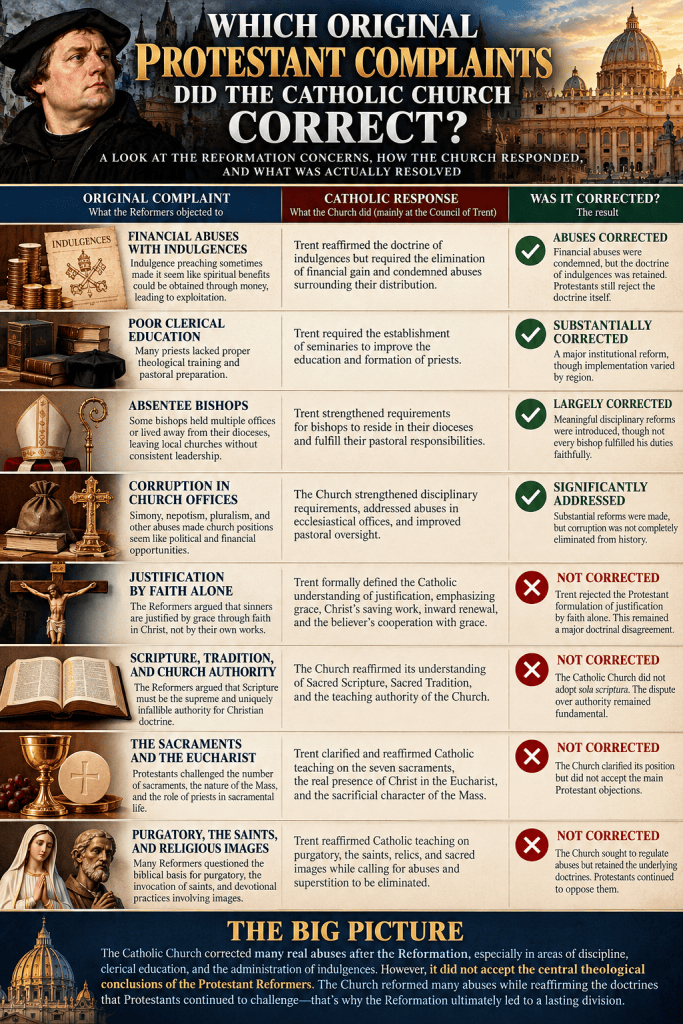
This distinction prevents two opposite historical mistakes.
The first is claiming that the Reformation was entirely unnecessary because the Church eventually reformed. The second is claiming that the Catholic Church never reformed because it did not accept Protestant doctrine.
Neither conclusion accurately captures what happened.
Some Protestant criticisms targeted abuses that Catholics themselves recognized and sought to correct. Other criticisms challenged teachings that the Catholic Church continued to regard as true.
8. Did the Catholic Church Become More Biblical After the Reformation?
This question requires a distinction between historical facts and theological evaluation.
Historically, the Catholic Church strengthened clerical education, tightened discipline, addressed abuses in indulgence administration, and clarified contested doctrines.
Whether these changes made Catholicism more faithful to Scripture depends partly on the theological standards by which that judgment is made.
A Protestant who believes that Scripture alone is the final infallible authority may conclude that Trent preserved serious doctrinal errors, particularly regarding justification, sacramental theology, and ecclesiastical authority.
A Catholic may argue that Trent corrected abuses while faithfully defending apostolic teaching against mistaken interpretations of Scripture.
Neither conclusion can be established merely by pointing to corrupt popes or well-behaved priests. Institutional misconduct can expose the need for reform, but it does not independently settle every doctrinal question.
Those questions require examining Scripture, the early Church, historical theology, and the arguments each tradition makes for its understanding of Christian authority.
For Protestant readers, this is particularly important: showing that a practice was abused is not the same as proving that the underlying doctrine was false. Conversely, showing that a doctrine was defended by church authorities does not, by itself, prove that it is biblical.
A serious historical and theological examination must do more than identify wrongdoing. It must evaluate the actual claims being made.
9. Why Didn’t the Reforms Bring Protestants Back?
If the Catholic Church corrected many of the abuses that helped trigger the Reformation, why did Protestantism continue to grow?
Because the division had become doctrinal, institutional, political, and social.
By the time Trent concluded in 1563, Protestant churches had developed their own confessions, systems of church government, theological institutions, and patterns of worship. European rulers and communities had also become invested in different religious settlements.
More importantly, the core theological disputes had not disappeared.
Catholics continued to affirm their understanding of justification, the sacraments, Tradition, and ecclesiastical authority. Protestants continued to argue that those teachings departed from biblical Christianity.
Even a perfectly administered Catholic Church would not automatically have resolved these disagreements.
There is also an important chronological distinction: Luther’s initial protest in 1517 preceded Trent by nearly three decades. The council’s reforms were a response to a crisis that had already developed into a major religious division. By then, restoring unity required more than correcting administrative misconduct.
The Reformation became a lasting division because it concerned not only how church leaders behaved, but also what Christians should believe and who had the authority to define those beliefs.
Conclusion: Reforming Abuses Is Not the Same as Reversing Doctrine
The Catholic Church of the late medieval and early modern periods faced genuine problems. Financial exploitation surrounding indulgences, poor clerical formation in some places, absentee leadership, political entanglements, and other abuses contributed to widespread calls for reform.
Martin Luther’s challenge emerged in that environment, but it developed into a deeper dispute over justification, Scripture, Tradition, the sacraments, and the authority of the Church.
The Catholic response was significant. Through the Council of Trent and the broader Catholic renewal, the Church strengthened priestly education, improved disciplinary structures, addressed financial abuses associated with indulgences, and clarified its doctrinal positions.
But the Church did not simply accept the Protestant understanding of Christianity.
It corrected many abuses while reaffirming the teachings that Protestants continued to dispute.
That leaves Christians with a more precise historical conclusion than either extreme allows: the Reformation arose amid real institutional failures, but it endured because Catholics and Protestants disagreed about the substance of Christian faith and authority.
For Christians examining the history today, the most productive approach is neither to dismiss every Protestant criticism as rebellion nor to assume that every Catholic doctrine must be false because church leaders behaved corruptly.
Instead, we should ask which criticisms were historically justified, which reforms actually occurred, which theological disagreements remain, and what the biblical and historical evidence supports.
Those are the questions worth pursuing if our goal is not merely to defend a tradition, but to understand the history of Christianity and seek the truth.
Sources for Further Study
These sources provide starting points for examining the historical evidence and the original documents behind the article.
- Council of Trent — Decree on Justification (1547). Read the council’s own account of justification, including its emphasis on grace, Christ’s saving work, inward renewal, and cooperation with grace. Read the decree and related historical material.
- Council of Trent — Decree on Indulgences (1563). A primary source for distinguishing the Catholic doctrine of indulgences from the financial abuses the council sought to eliminate. Read the decree.
- Council of Trent — Historical overview. A detailed account of the council’s sessions, doctrinal decisions, and disciplinary reforms. Read the Catholic Encyclopedia’s account.
- Ephesians 2:1–10; Romans 3:21–31; Romans 4:1–8; James 2:14–26. These biblical passages are central to discussions of grace, faith, justification, and works. Read them in context and compare how Protestant and Catholic interpreters understand their relationship.
- Martin Luther — The Ninety-Five Theses (1517). Read the original document to see how Luther’s early objections focused on indulgences, repentance, and the responsibilities of church leaders. Read the text.
A final note on historical method: The Council of Trent’s decrees are primary sources for what the Catholic Church formally taught and reformed. Luther’s writings are primary sources for the development of Protestant objections. Studying both alongside Scripture and reliable historical scholarship gives readers a stronger foundation than relying exclusively on modern Catholic or Protestant summaries.

Click the Image to
Get Your FREE Christian Apologetic Starter Pack
Study the Bible Deeper
• If you’re serious about growing in your understanding of Scripture, I highly encourage you to try Logos Bible Software—you can start with a free trial and see how it transforms your study time. — FREE TRIAL
• And for solid, biblically sound books and resources, take a look at ChristianBook.com—a great place to build your library. — CLICK HERE
Discover more from Mathetes Mission
Subscribe to get the latest posts sent to your email.


