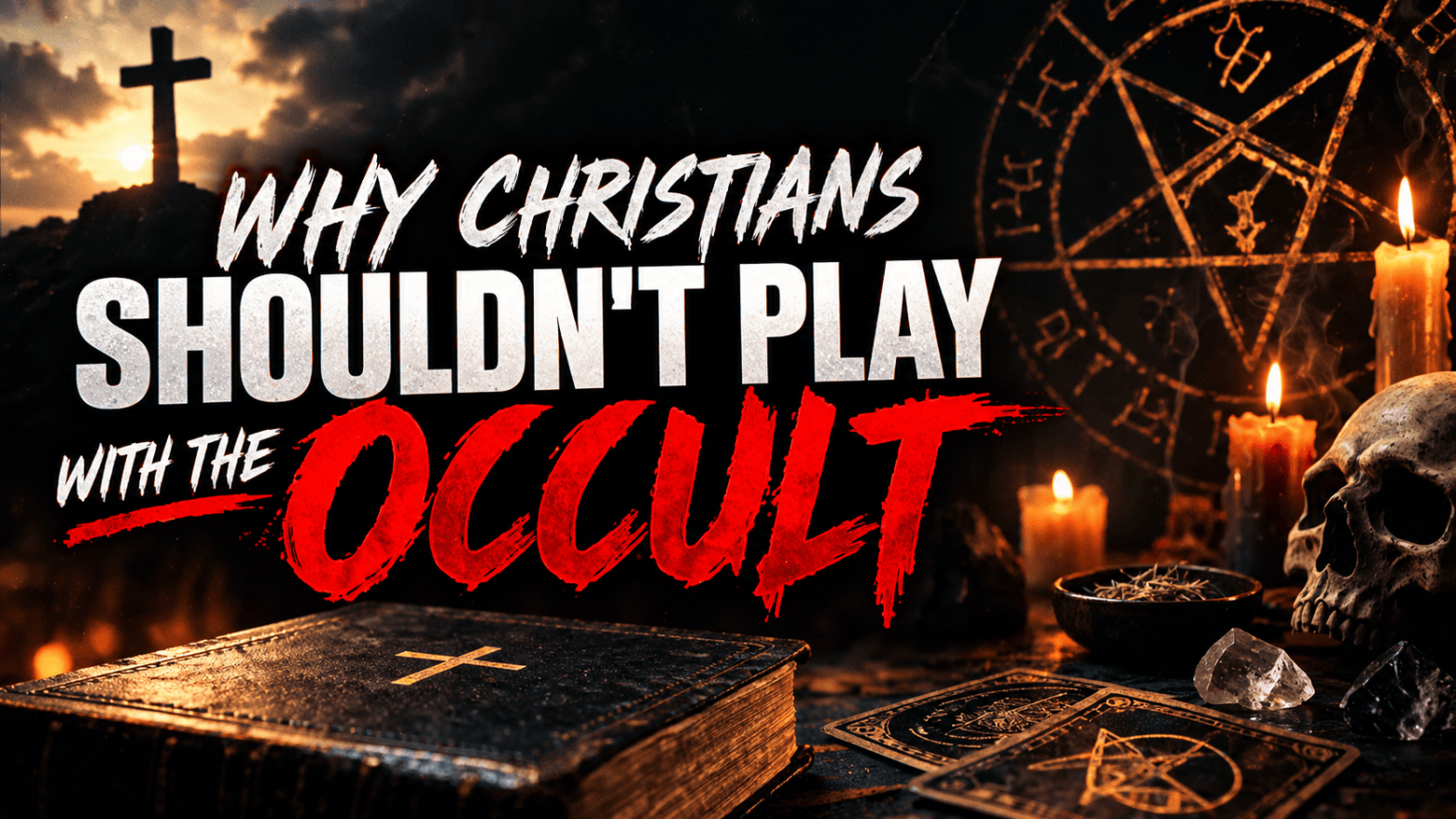
Halloween often brings supernatural themes into the spotlight.
Witches. Tarot cards. Ouija boards. Ghosts. Mediums. Fortune-telling. Séances. Spells. Demons.
Some people view these things as harmless entertainment. Others genuinely practice them. And Christians sometimes wonder where the biblical line is.
Is it really a big deal to use a Ouija board “just for fun”?
What about tarot cards?
What if someone doesn’t actually believe in witchcraft?
What if it’s only a Halloween party?
The Bible gives us a much clearer answer than we might expect.
Christians are called to stay away from occult practices—not because Christians need to live in fear of the supernatural, but because God calls His people to seek Him rather than supernatural knowledge or power through forbidden means.
What Does the Bible Mean by Occult Practices?
The Bible doesn’t use the modern English word occult as a single technical category.
Instead, Scripture describes a number of practices involving attempts to obtain supernatural knowledge, guidance, or power apart from God.
Deuteronomy 18 lists several of them:
10 There shall not be found among you anyone who burns his son or his daughter as an offering, anyone who practices divination or tells fortunes or interprets omens, or a sorcerer 11 or a charmer or a medium or a necromancer or one who inquires of the dead, 12 for whoever does these things is an abomination to the Lord. (Deuteronomy 18:10–12)
God then tells Israel:
You shall be blameless before the Lord your God, (Deuteronomy 18:13)
The issue isn’t merely that these practices are strange.
They represent seeking supernatural guidance or power somewhere other than God.
“But That Was the Old Testament”
This is an important question, especially considering the distinction between the Mosaic covenant and the New Covenant.
Christians aren’t under the Mosaic covenant as Israel was. The civil and ceremonial aspects of that covenant aren’t imposed upon Christians as though the church were the nation of Israel.
But that doesn’t mean everything God condemned in the Old Testament suddenly becomes morally acceptable.
The New Testament continues to recognize sorcery and related practices as incompatible with Christian discipleship.
In Acts 19, people who became Christians in Ephesus publicly abandoned their magical practices:
Also many of those who were now believers came, confessing and divulging their practices. (Acts 19:18)
Then:
And a number of those who had practiced magic arts brought their books together and burned them in the sight of all… (Acts 19:19)
That’s significant.
These weren’t people merely learning about magic academically.
They were practicing it.
And when they became followers of Christ, they didn’t simply continue doing it while adding Christianity to their lives.
They abandoned it.
What About Ouija Boards?
A Ouija board is marketed as a way of communicating with spirits or receiving answers through supernatural means.
Whatever someone believes about the supposed mechanism behind it, the intention is the important biblical question:
Are you attempting to communicate with supernatural entities or receive supernatural information?
That is precisely the kind of activity Scripture warns God’s people against.
Deuteronomy 18 specifically prohibits consulting mediums, necromancers, and those who inquire of the dead.
Therefore, a Christian shouldn’t treat a Ouija board as a harmless spiritual game.
The phrase “I’m only doing it for fun” doesn’t change what the activity is actually attempting to do.
What About Tarot Cards?
Tarot cards deserve a similar distinction.
There’s nothing inherently supernatural about pieces of cardboard with pictures printed on them.
The issue is how they’re being used.
Using tarot imagery in artwork or studying the history of tarot cards isn’t equivalent to using tarot cards for divination.
But using tarot cards to tell someone’s future, reveal hidden knowledge, communicate with spirits, or obtain supernatural guidance falls directly into the category of practices Scripture warns against.
The biblical alternative isn’t to find a different supernatural method.
It is to seek God.
James writes:
If any of you lacks wisdom, let him ask God, who gives generously to all without reproach, and it will be given him. (James 1:5)
That’s a radically different approach.
Don’t seek hidden knowledge through divination.
Ask God for wisdom.
What About Mediums and Séances?
The Bible is especially direct about attempting to communicate with the dead.
Leviticus says:
“Do not turn to mediums or necromancers; do not seek them out, and so make yourselves unclean by them: I am the Lord your God. (Leviticus 19:31)
Deuteronomy similarly prohibits “one who inquires of the dead”, as we’ve discussed already.
This means Christians shouldn’t participate in séances or attempt to contact deceased people through mediums.
That includes doing it as a joke.
It includes doing it because you’re curious.
It includes doing it because you don’t personally believe it works.
The biblical command is to not seek it out.
What About Witchcraft?
The Bible also consistently treats sorcery as something Christians should reject.
Galatians 5:19–21 includes sorcery among the works of the flesh.
The biblical problem isn’t simply that witchcraft involves “spooky” imagery.
It represents pursuing supernatural power through means that reject dependence upon God.
Christianity doesn’t teach:
“There is no supernatural world.”
It teaches:
“God is Lord over the supernatural world, and His people should not seek forbidden spiritual power.”
That’s an important distinction.
But Are Demons Actually Real?
According to Christianity, yes.
The Bible teaches the existence of Satan and other spiritual beings.
But Christians need to avoid two opposite mistakes.
The first is denying the spiritual realm altogether.
The second is becoming obsessed with it.
Scripture doesn’t tell Christians to spend their lives trying to identify demons, communicate with spirits, or discover secret supernatural knowledge.
Our focus is Christ.
Paul’s message to the Ephesians is particularly striking because the church existed in a culture where magic was practiced. When people became Christians, they turned away from their magical practices and the gospel continued to spread.
The answer to occultism wasn’t deeper occult knowledge.
It was Jesus.
What About Fiction?
This is where Christians need to exercise wisdom rather than treating every fictional supernatural story as though it were an actual occult practice.
Reading a fantasy novel doesn’t automatically mean you’re practicing magic.
Watching a fictional movie about witches doesn’t mean you’ve become a witch.
Dressing up as a fictional character doesn’t necessarily mean you’re endorsing everything that character represents.
There is a difference between depiction and participation.
For example, a Christian could watch a fictional story involving a supernatural battle without believing the story represents reality.
But that doesn’t mean every piece of entertainment is automatically healthy.
Christians should still consider what a particular piece of entertainment celebrates, glorifies, normalizes, or encourages.
Philippians 4:8 gives us a useful framework for thinking about what we allow to occupy our minds.
So the question shouldn’t simply be:
“Is there magic in this movie?”
It should also be:
“What does this story do with evil?”
Does it portray evil as evil?
Does it glorify occult practices?
Does it encourage fascination with the occult?
Does it make sin attractive?
Does it disturb your conscience?
Those questions require wisdom.
Don’t Confuse Curiosity With Wisdom
One of the most dangerous ideas surrounding occultism is:
“I’m just curious.”
Curiosity itself isn’t sinful.
Christians should absolutely be curious about how other religions and spiritual practices work. Apologetics requires understanding what other people believe.
But there is a difference between studying an occult practice and participating in it.
You can study astrology without practicing astrology.
You can study witchcraft historically without practicing witchcraft.
You can study pagan religions without worshiping their gods.
You can explain what tarot is without using tarot to tell someone’s future.
Apologetics requires understanding false ideas well enough to answer them.
But understanding something doesn’t require experimenting with it.
Why Does God Care?
At the heart of all this, is a question of worship and trust.
God doesn’t forbid divination because He wants Christians to remain ignorant.
He forbids it because He wants His people to trust Him.
Imagine someone saying:
“God, I don’t know what to do. Instead of asking You, I’m going to consult a medium.”
The problem isn’t merely the method.
It’s where the person is looking for guidance.
God has given His people His Word.
He invites us to pray.
He gives wisdom.
He gives the Holy Spirit.
He gives the church.
He gives us brothers and sisters in Christ who can offer godly counsel.
Christians don’t need to search the spiritual world for secret knowledge when God has already revealed what we need for faithful living.
What Should Christians Do Instead?
When you’re afraid, pray.
When you don’t know what to do, ask God for wisdom.
When you’re tempted, run to Christ.
When you want to know God’s will, study His Word.
When you’re suffering, bring your suffering to God.
When you’re curious about the supernatural, study what Scripture actually teaches.
And when someone claims to have supernatural knowledge, test the claim against God’s revealed truth rather than automatically believing it.
The Christian life isn’t about discovering hidden spiritual secrets.
It’s about knowing Christ.

Click the Image to
Get Your FREE Christian Apologetic Starter Pack
Study the Bible Deeper
• If you’re serious about growing in your understanding of Scripture, I highly encourage you to try Logos Bible Software—you can start with a free trial and see how it transforms your study time. — FREE TRIAL
• And for solid, biblically sound books and resources, take a look at ChristianBook.com—a great place to build your library. — CLICK HERE
Discover more from Mathetes Mission
Subscribe to get the latest posts sent to your email.


