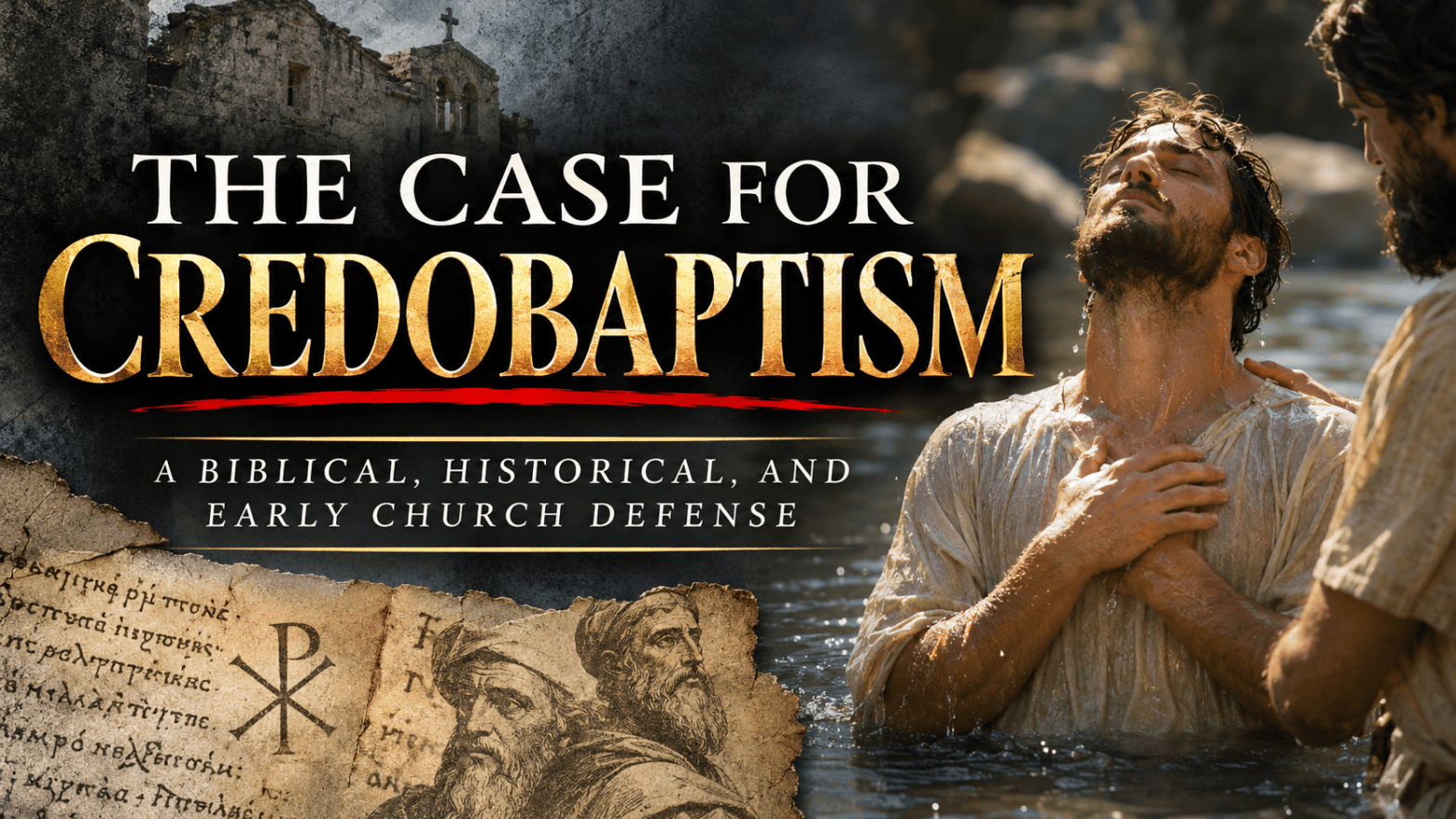
An examination of New Testament exegesis, covenant theology, early Christian writings, and the historical development of Christian baptism.
Few theological disagreements among Christians are as longstanding as the question of who should receive baptism. Paedobaptists maintain that the children of Christian believers should receive baptism as members of the covenant community, drawing parallels between circumcision in the Old Testament and baptism in the New Testament. Credobaptists, on the other hand, maintain that baptism is intended for those who personally repent, believe in Jesus Christ, and publicly identify themselves with Him.
The purpose of this article is to present a positive biblical and historical defense of credobaptism, rather than simply criticize infant baptism. The central argument is straightforward: The New Testament consistently presents baptism as the response of someone who has heard the gospel, repented, believed, and identified with Christ.
This position does not require denying that God works through families, that children of believers have a privileged place within the Christian community, or that infant baptism has an ancient history. Rather, it asks whether the New Testament actually establishes baptism as the appropriate sign for infants of Christian parents.
1. The New Testament Pattern: Faith Before Baptism
The most consistent pattern throughout the New Testament is that baptism follows an individual’s response to the gospel.
Consider Peter’s instructions at Pentecost:
And Peter said to them, “Repent and be baptized every one of you in the name of Jesus Christ for the forgiveness of your sins, and you will receive the gift of the Holy Spirit. (Acts 2:38, ESV)
Notice the sequence: repentance and baptism. Peter addresses those who have heard the gospel and are being called to respond to it.
Acts 2:41 then explains:
So those who received his word were baptized, and there were added that day about three thousand souls. (Acts 2:41, ESV)
The recipients are identified as those who received the apostolic message.
The same pattern appears throughout Acts:
- Acts 8:12: Men and women believe Philip’s preaching concerning the kingdom of God and Jesus Christ and are baptized.
- Acts 8:36–38: The Ethiopian eunuch hears the gospel, confesses his faith, and receives baptism.
- Acts 10:44–48: Cornelius and his household receive the Holy Spirit, after which Peter commands their baptism.
- Acts 16:30–34: The Philippian jailer hears the gospel, believes, and is baptized with his household.
These passages do not merely describe baptism as something administered to individuals because of their family relationships. They repeatedly associate it with hearing, believing, and responding to the gospel.
This is particularly significant because Acts records the expansion of Christianity from Jerusalem into the Gentile world. If the apostles intended to establish infant baptism as the ordinary practice for Christian households, these missionary accounts would have provided natural opportunities to demonstrate it.
Instead, the recurring emphasis is personal reception of the gospel.
This does not prove that no infant was ever baptized in an apostolic household. It does, however, establish the positive pattern that credobaptists argue should govern Christian baptism.
2. The New Covenant and the Circumcision Argument
One of the strongest paedobaptist arguments comes from Colossians 2:11–12, where Paul connects circumcision and baptism:
In him also you were circumcised with a circumcision made without hands, by putting off the body of the flesh, by the circumcision of Christ, having been buried with him in baptism, in which you were also raised with him through faith in the powerful working of God, who raised him from the dead. (Colossians 2:11–12, ESV)
Paedobaptists argue that baptism replaces circumcision as the covenant sign. Since circumcision was administered to male infants under the Abrahamic covenant, they maintain that baptism should likewise be administered to children of believers.
However, there are important distinctions in Paul’s argument.
First, Paul describes the spiritual reality associated with baptism as participation in Christ’s death and resurrection. Second, he explicitly associates being raised with Christ with faith.
The passage does not explicitly say that baptism replaces circumcision as an outward covenant sign, nor does it command the baptism of believers’ children.
The New Testament describes the new covenant in terms of people who know the Lord (Jeremiah 31:31–34; Hebrews 8:6–13). Unlike the national and genealogical structure of Israel, the church is constituted through the proclamation of the gospel and personal allegiance to Christ.
This does not mean that every professing Christian is genuinely regenerate. Rather, it means that the church’s baptismal practice should reflect the new covenant’s stated qualifications: repentance, faith, and discipleship.
The credobaptist position does not need to deny continuity between the covenants. It simply argues that continuity does not automatically establish identical membership requirements or identical administration of covenant signs.
3. What About Household Baptisms?
Perhaps the most frequently cited objection to credobaptism is the baptism of entire households.
Acts 16 records the baptism of Lydia’s household (Acts 16:14–15), as well as the Philippian jailer’s household (Acts 16:31–34).
Paedobaptists reasonably argue that household language could include infants and children. That possibility should not be dismissed.
However, possibility is not proof.
In the Philippian jailer’s account, Paul and Silas proclaim the word of the Lord to everyone in the household. The passage then describes the household rejoicing because they had believed in God.
Similarly, Acts 18:8 describes Crispus believing in the Lord together with his entire household.
These accounts are consistent with household members responding to the gospel together.
Another important passage is 1 Corinthians 7:14:
For the unbelieving husband is made holy because of his wife, and the unbelieving wife is made holy because of her husband. Otherwise your children would be unclean, but as it is, they are holy. (1 Corinthians 7:14, ESV)
Paedobaptists understand this passage as evidence that children of believers occupy a special covenantal status.
Credobaptists can acknowledge that distinction without concluding that the children should therefore be baptized. Paul is discussing the sanctifying influence of a believing spouse and the holiness of the household, not establishing baptismal eligibility.
Being set apart within a Christian household is not necessarily identical to possessing the qualifications for baptism.
Ultimately, none of these household passages actually identifies an infant being baptized.
4. The Historical Evidence: What Did the Early Church Actually Practice?
Historical evidence deserves serious consideration, particularly when examining claims about apostolic tradition.
The earliest surviving Christian writings provide valuable insight into baptismal practices, although they do not establish a completely uniform picture.
The Didache (Approximately Late First or Early Second Century)
The Didache, an early Christian instructional document, provides instructions concerning baptism in chapter 7.
It instructs candidates to receive teaching and fast before baptism, along with the person administering baptism.
The document also provides instructions concerning baptism in running water and allows alternative methods when necessary.
Although the Didache does not explicitly prohibit infant baptism, its instructions reflect a baptismal process involving preparation and instruction meant for grown individuals.
This is consistent with the credobaptist emphasis on baptism as an intentional response to Christian teaching.
Importantly, silence regarding infants cannot establish that infant baptism did not exist. But the Didache provides no explicit evidence of an established infant-baptism requirement.
Justin Martyr (Approximately AD 150–160)
In First Apology, chapter 61, Justin Martyr describes Christian baptism.
He explains that those who believe the Christian teaching, accept it, and commit themselves to living accordingly are brought to a place where water is available and baptized.
Justin’s description emphasizes belief, commitment, and instruction before baptism.
This is significant evidence of the importance of personal faith in early Christian initiation.
Justin does not explicitly state that infants were excluded. His account describes the preparation of converts rather than providing a comprehensive statement about every possible baptismal recipient.
Tertullian (Approximately AD 200)
One of the most interesting early witnesses is Tertullian, particularly in On Baptism, chapter 18.
Tertullian discusses the baptism of young children and actually recommends delaying their baptism.
He argues that sponsors could be placed in difficult positions by making commitments on behalf of children who could not yet understand the significance of baptism.
His recommendation is particularly noteworthy.
He prefers that children come to baptism when they are able to understand Christ and request baptism themselves.
This is not an insignificant historical observation. Tertullian demonstrates that the question of baptizing infants was already being discussed in the early third century, and that at least one influential Christian theologian advocated waiting until children could personally understand the faith.
It would be historically inaccurate to claim that Tertullian proves infant baptism was unknown. He plainly knew of the practice. Regardless, his objections demonstrate that delaying baptism until personal understanding was an identifiable early Christian position.
Origen and Cyprian (Third Century)
The historical evidence becomes increasingly explicit during the third century.
Origen, in his Homilies on Leviticus 8.3 and other writings, describes infant baptism as an established church practice and associates it with apostolic tradition.
Likewise, Cyprian of Carthage, in Letter 64 (also numbered Letter 59 in some older collections), records a decision by a council of bishops in AD 252 concerning the baptism of newborn children.
The council concluded that baptism should not be delayed until the eighth day after birth.
These sources demonstrate that infant baptism was established in significant portions of Christianity by the third century.
Consequently, a credible defense of credobaptism should not pretend that the early church unanimously practiced believers-only baptism.
However, neither should the existence of an early practice automatically establish its apostolic origin or its biblical necessity.
As church historian Everett Ferguson demonstrates in Baptism in the Early Church: History, Theology, and Liturgy in the First Five Centuries (2009), the historical development of baptism involved considerable variation in practice, theological explanation, and administration. Even many of the early Church fathers were not baptized until adulthood, though they held off for different reasons.
The historical evidence must therefore be evaluated rather than simply appealed to as a final authority.
5. Baptism as a Public Identification With Christ
Perhaps the strongest theological argument for credobaptism is the relationship between baptism and discipleship.
In Matthew 28:19–20, Jesus commands His disciples to make disciples of all nations, baptizing them and teaching them to observe everything He commanded.
The sequence presents baptism within the broader process of making disciples.
Likewise, Romans 6:3–4 describes baptism as identification with Christ’s death, burial, and resurrection.
Baptism visibly represents the believer’s union with Christ and the beginning of a new life.
Peter also connects baptism with an appeal to God for a good conscience in 1 Peter 3:21.
Although Christians disagree about the precise relationship between baptism, regeneration, and salvation, the passage unmistakably presents baptism as something associated with a conscious response toward God.
Credobaptism therefore maintains that baptism should ordinarily be administered to those who can personally profess the faith that baptism represents.
It does not require the baptizer to know with certainty that someone is regenerate. Rather, it requires a credible profession of faith.
What Does the New Testament Actually Require?
The historical existence of infant baptism is undeniable, and Christians should be honest about that evidence. But the existence of an early practice established by the 4th century does not independently establish that the apostles commanded it.
The strongest case for credobaptism rests on the cumulative biblical pattern:
- The New Testament repeatedly connects baptism with repentance and personal faith.
- The Great Commission places baptism within the making of disciples.
- Colossians 2 does not explicitly establish baptism as a replacement for infant circumcision, otherwise only male infants would be baptized too.
- Household baptisms never explicitly identify infants as recipients.
- Early Christian sources demonstrate the importance of instruction, belief, and personal commitment for baptism.
- Tertullian provides early evidence of opposition to baptizing children before they can understand the faith.
Ultimately, the question is not whether Christian parents love their children, whether children belong in the Christian community, or whether God works through families.
The question is whether Scripture authorizes the administration of baptism to someone who has not personally professed faith in Christ.
Credobaptism argues that the clearest biblical answer is that baptism belongs to those who have heard the gospel, repented, believed, and willingly identified themselves with Jesus Christ.
The consistent New Testament emphasis is not on the faith of a parent being credited to a child for baptismal purposes, but on the individual’s response to the gospel.
For that reason, credobaptism maintains that baptism should follow a personal profession of faith.
For a much more in-depth review of this topic, check out a Doctor of Philosophy (Ph.D.) in Historical Theology—Gavin Ortlund—video here: https://youtu.be/3WE0Ea2ke_c?is=UBh-iwwknxsCyZdP

Click the Image to
Get Your FREE Christian Apologetic Starter Pack
Study the Bible Deeper
• If you’re serious about growing in your understanding of Scripture, I highly encourage you to try Logos Bible Software—you can start with a free trial and see how it transforms your study time. — FREE TRIAL
• And for solid, biblically sound books and resources, take a look at ChristianBook.com—a great place to build your library. — CLICK HERE
Discover more from Mathetes Mission
Subscribe to get the latest posts sent to your email.


