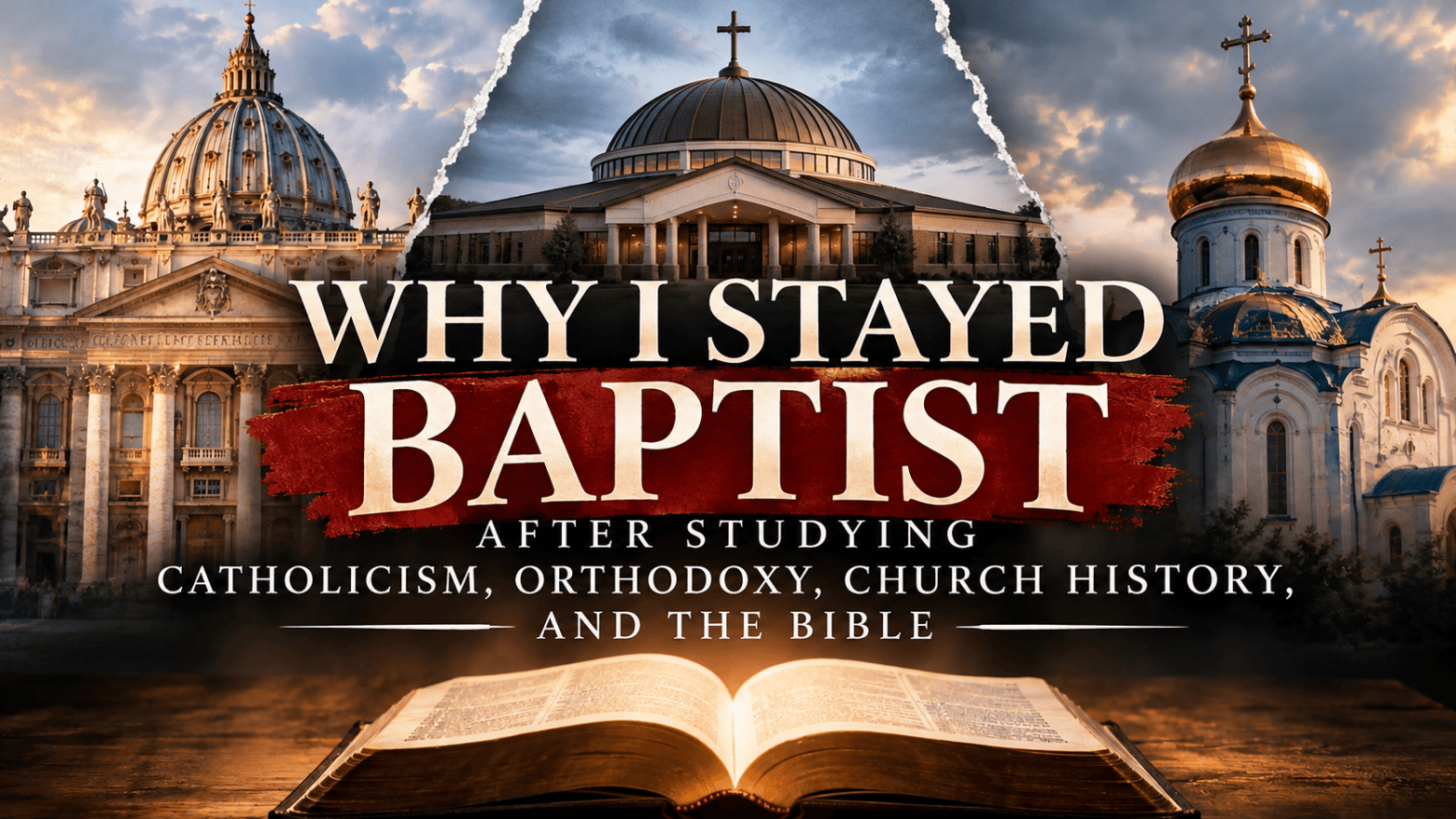
I didn’t stay Baptist because I never explored the alternatives. I stayed because after seriously investigating Catholicism, Eastern Orthodoxy, early Church history, and Scripture, I ultimately found that I couldn’t confidently accept the additional claims required of me.
For quite some time, I genuinely thought I might become Catholic.
I wasn’t casually exploring the idea, either. I spent countless hours studying Catholic theology, reading the Catechism of the Catholic Church, following Catholic apologists, researching the early Church Fathers, examining ecumenical councils, going to adoration, and comparing Catholic interpretations of Scripture against Protestant interpretations.
I also explored Eastern Orthodoxy, particularly its claims about apostolic succession, the authority of the early Church, and its understanding of Christian tradition.
I wanted to get it right.
I didn’t want to remain Baptist simply because that’s what I am familiar with.
I didn’t want to reject Catholicism because of misunderstandings or Protestant talking points. If Catholicism or Orthodoxy represented the fullness of the Church Christ established, I wanted to know.
But after all that research, prayer, reading, and reconsideration, I eventually reached a different conclusion.
I decided to remain Baptist.
Not because I believe Baptists have everything figured out. Not because I think Catholicism and Orthodoxy have nothing valuable to offer. And certainly not because I believe every Protestant denomination represents biblical Christianity faithfully.
I stayed because I ultimately found that several foundational claims of Catholicism and Orthodoxy required a level of certainty that I couldn’t establish from Scripture or the available historical evidence.
Here are the biggest reasons.
1. Scripture must remain the final authority
One of the biggest differences I encountered was the question of authority.
Catholicism teaches that Scripture and Sacred Tradition form one deposit of faith, authentically interpreted by the Church’s Magisterium. Eastern Orthodoxy also understands Scripture within the authoritative tradition of the Church.
I understand the reasoning behind these positions.
The early Christians didn’t have a completed New Testament sitting on their bookshelves. The apostles taught, churches received letters, bishops exercised authority, and Christians relied on the teaching handed down to them.
I don’t dispute that.
However, I believe we must distinguish between the authority of the apostles, the authority of Scripture, and the authority exercised by later church leaders.
The apostles possessed a unique authority as Christ’s appointed witnesses. Their teaching was foundational to the Church.
Paul even commended the Bereans because they examined the Scriptures to determine whether his teaching was true.
Now these Jews were more noble than those in Thessalonica; they received the word with all eagerness, examining the Scriptures daily to see if these things were so. (Acts 17:11)
That principle matters.
Even when someone possesses a position of religious authority, their teaching should not become immune from examination.
I believe Scripture is God-breathed and uniquely authoritative.
All Scripture is breathed out by God and profitable for teaching, for reproof, for correction, and for training in righteousness, that the man of God may be complete, equipped for every good work. (2 Timothy 3:16–17)
My concern with Catholicism and Orthodoxy isn’t that they value tradition. Tradition is important, and the historical Church deserves serious consideration.
My concern is what happens when later ecclesiastical claims are treated as binding Christian doctrine without sufficient demonstration that those claims were actually delivered by Christ or the apostles.
I don’t believe historical continuity automatically establishes doctrinal infallibility.
A church can be ancient, historically significant, and institutionally continuous without every subsequent theological development necessarily being apostolic.
I need to be convinced that a teaching is true, not simply that an institution has declared it true.
2. The burden of proving infallibility is enormous
This was probably one of the most significant issues in my investigation.
Catholicism makes some extraordinary claims about the authority of the Church, particularly the infallibility of the pope under specific conditions and the infallibility of the Church’s definitive teachings on faith and morals.
Orthodoxy rejects papal supremacy as understood by Rome but maintains its own understanding of the authority of ecumenical councils and the Church’s reception of doctrinal decisions.
These aren’t minor differences.
If an institution claims that certain teachings are protected from error by the Holy Spirit, I need to understand how we can reliably identify those teachings and establish that the institution actually possesses that protection. It’s not like they are sitting down with the Holy Spirit to discuss these matters. They actually usually form infallible doctrines with their backs against the wall.
This becomes especially important when examining historical councils, disagreements among bishops, conflicting interpretations, and the development of doctrine.
I found myself repeatedly asking:
How do we distinguish legitimate doctrinal development from an actual departure from apostolic teaching?
How do we know which historical interpretations are authoritative?
What happens when supposedly authoritative teachings disagree?
And perhaps most importantly, what independently establishes that the institution claiming infallibility actually possesses it?
I don’t believe these questions can simply be answered by appealing to the authority being questioned. That creates a circular problem.
I understand the Catholic response that the Church’s authority is established through Scripture, apostolic succession, and historical continuity. I also understand the Orthodox appeal to the consensus and reception of the Church.
But I don’t believe those arguments automatically establish every subsequent claim made by either communion.
The burden of proof becomes especially significant when a person is expected to accept doctrines as divinely revealed rather than merely permissible theological opinions.
I would rather admit that I don’t know something than pretend to possess certainty that I haven’t established.
3. The biblical canon presents a serious problem
Another major issue was the canon of Scripture.
Catholicism recognizes 73 books in its Old and New Testaments, while Protestants recognize 66.
Orthodoxy generally has a broader Old Testament canon, although the precise contents vary among Orthodox traditions.
I spent considerable time examining the deuterocanonical books, their historical usage, their differences from the other biblical writings, and the historical debates surrounding their status.
I don’t believe these books are worthless.
Tobit, Judith, Wisdom, Sirach, Baruch, and 1 and 2 Maccabees contain historically and spiritually valuable material. They deserve to be read and understood within their historical context.
As Catholics own Saint Jerome’s Preface to the Books of Solomon (398–405 AD) states:
“As, then, the Church reads Judith, Tobit, and the books of Maccabees, but does not admit them among the canonical Scriptures, so let it also read these two volumes [Wisdom and Sirach] for the edification of the people, not to give authority to doctrines of the Church.”
The question isn’t whether a book contains wisdom or whether Christians throughout history have found it beneficial.
The question is whether it is divinely inspired.
And that distinction matters tremendously.
If the Church’s authority is necessary to establish the canon, but the Church’s authority is itself one of the things being investigated, we still need a convincing historical and theological argument.
I don’t believe simply declaring a particular canon infallibly settles the underlying historical questions.
I also recognize that Protestants must explain their own canon rather than assume that having 66 books automatically resolves every historical difficulty.
Nevertheless, I remain convinced that the Protestant canon is the most defensible position based on my understanding of the historical and theological evidence.
4. Salvation should not become dependent on additional ecclesiastical obligations
This is another issue that became increasingly important during my investigation.
I believe Christians are called to holiness, obedience, self-denial, fasting, prayer, generosity, and repentance.
I have absolutely no problem with fasting.
Jesus fasted. The apostles fasted. The early Christians fasted. Fasting can be an incredibly beneficial spiritual discipline.
My concern isn’t fasting itself.
My concern is when additional religious obligations become binding under circumstances where knowingly violating them can potentially constitute grave sin.
For example, Catholicism and Eastern Orthodox have obligatory fasting and abstinence requirements subject to the applicable rules and exceptions.
Catholic moral theology distinguishes between the objective seriousness of an offense and the personal culpability necessary for mortal sin. Grave matter, sufficient knowledge, and deliberate consent are required.
Therefore, missing a fast does not automatically mean someone has lost salvation.
However, the possibility that knowingly and freely disregarding a binding ecclesiastical discipline could constitute mortal sin is something I struggled with.
Why should a Christian’s standing before God potentially become entangled with obligations established by later ecclesiastical authority?
I understand the Catholic argument that Christ gave His Church authority to establish disciplinary requirements and that obedience to legitimate authority is itself a Christian obligation.
But I don’t believe every ecclesiastical requirement should carry the kind of spiritual weight that can place a person’s soul in jeopardy without a sufficiently demonstrated biblical and apostolic foundation.
I see a distinction between fasting because Scripture calls us to humility, repentance, and devotion to God, and being bound by an extensive religious calendar with particular requirements.
Therefore let no one pass judgment on you in questions of food and drink, or with regard to a festival or a new moon or a Sabbath. These are a shadow of the things to come, but the substance belongs to Christ. (Colossians 2:16–17)
Paul’s warning deserves serious consideration.
Christian liberty does not mean Christians can disregard God’s commands. But neither should human regulations be elevated to the level of divine requirements without sufficient justification.
I would rather encourage Christians to fast willingly, joyfully, and regularly than create another system in which people become preoccupied with whether they have fulfilled every religious obligation.
My faith is in Christ, not my ability to maintain an ecclesiastical calendar.
5. Church history is important, but historical development isn’t automatically proof of apostolic origin
I genuinely love studying early Church history.
I think Christians should know what happened after the apostles, understand the early Church Fathers, study the ecumenical councils, and examine how Christian theology developed.
Ignatius of Antioch, Justin Martyr, Irenaeus, Tertullian, Origen, Athanasius, Augustine, and many others provide tremendous insight into the beliefs and practices of early Christians.
Studying them helped me understand just how much early Christianity differed from some expressions of modern Protestantism.
I also discovered that the early Church was not a monolithic institution where every bishop agreed on every theological question.
There were disagreements, competing interpretations, disputed writings, disciplinary differences, and theological controversies.
Some early Christian writers held positions that later Christians would reject.
Even respected Church Fathers could be mistaken.
This doesn’t mean we should dismiss them. Quite the opposite.
Their writings are valuable precisely because they help us understand what Christians believed, practiced, debated, and passed down.
But historical evidence must be examined rather than selectively presented.
Finding an early Christian reference to something resembling a later Catholic or Orthodox practice doesn’t automatically establish that the complete modern doctrine was believed in the same form.
Likewise, finding an early Christian expression that resembles Protestant theology doesn’t automatically establish that the early Church was Protestant.
We need to distinguish between historical continuity, theological development, and later doctrinal definitions.
I don’t believe we should force the early Church into modern denominational categories.
I also don’t believe we should assume that every later development was necessarily intended by the apostles.
6. I don’t believe unity requires accepting every claim made by a particular institution
One of the strongest attractions of Catholicism and Orthodoxy was their emphasis on a visible, historic Church.
I genuinely appreciate the desire for Christian unity.
I don’t want thousands of denominations. I don’t want churches abandoning biblical Christianity to accommodate cultural trends. I don’t want pastors reinventing Christian doctrine every generation.
I want a Church that takes Scripture seriously, preserves the gospel, teaches sound doctrine, and remains faithful to Christ.
However, I eventually realized that the desire for visible unity doesn’t automatically establish the authority claims of Rome or Constantinople.
There is a difference between believing Christ established a visible Church and believing that one particular institution has conclusively demonstrated that it alone possesses the fullness of Christ’s authority in the manner it claims.
I believe Christians should pursue unity.
But unity in Christ, not institutions.
There is one body and one Spirit—just as you were called to the one hope that belongs to your call—one Lord, one faith, one baptism, one God and Father of all, who is over all and through all and in all. (Ephesians 4:4–6)
I believe the Church’s unity is ultimately grounded in Christ.
That doesn’t mean denominational division is unimportant or that Christians should be comfortable with fragmentation.
It means I cannot accept a particular institutional claim simply because the alternative is uncomfortable.
7. I found myself appreciating the simplicity of the gospel again
Perhaps the biggest thing that happened throughout this entire process was that I began reconsidering what originally brought me to Christianity.
The Gospel.
Jesus Christ lived, died, and rose again. We are sinners in need of redemption, and salvation is God’s gracious gift through faith in Jesus Christ.
That doesn’t mean obedience is optional.
It doesn’t mean repentance is unnecessary.
It doesn’t mean good works don’t matter.
Genuine faith produces genuine fruit. A Christian should desire holiness, pursue righteousness, forgive others, love their neighbors, and remain faithful to Christ.
But our hope isn’t ultimately grounded in our ability to satisfy an expanding list of religious requirements.
For by grace you have been saved through faith. And this is not your own doing; it is the gift of God, not a result of works, so that no one may boast. For we are his workmanship, created in Christ Jesus for good works, which God prepared beforehand, that we should walk in them. (Ephesians 2:8–10)
Notice the relationship between grace, faith, and good works.
We are saved by grace through faith, and we are created in Christ Jesus for good works.
Good works matter tremendously. But they are the fruit of God’s grace, not something we can use to boast about earning our salvation.
I don’t want to lose sight of that.
I want to spend my time knowing Christ, understanding His Word, loving my family, serving others, sharing the gospel, and becoming more like Him.
I want my faith to be centered on Jesus Christ.
8. I found a conservative Baptist church that takes Scripture and the gospel seriously
Ultimately, I realized that I didn’t need to abandon my Baptist church simply because I had discovered that Catholicism and Orthodoxy possessed historical arguments worth investigating.
There are legitimate weaknesses within Protestantism.
There are liberal churches that have abandoned biblical authority. There are pastors who distort the gospel. There are denominations that have compromised essential Christian teachings.
But those problems aren’t unique to Protestantism.
Catholicism and Orthodoxy have their own historical controversies, internal disagreements, theological difficulties, and institutional problems.
I don’t believe any Christian tradition should be evaluated exclusively by its best representatives while judging competing traditions by their worst.
I want to be part of a church that:
- Treats Scripture as the final authority for Christian faith and practice.
- Preaches salvation by grace through faith in Jesus Christ.
- Teaches repentance, obedience, and genuine Christian holiness.
- Takes the resurrection and Christianity seriously.
- Values church history without treating every later development as automatically apostolic or infallible.
- Encourages prayer, fasting, worship, fellowship, and service without unnecessarily binding Christian consciences.
- Rejects theological liberalism and remains committed to the biblical gospel.
I found those things in a conservative Baptist congregation.
And I don’t believe I need to leave that environment simply because another tradition has an older institutional structure or makes more expansive claims about its authority.
I can appreciate the early Church Fathers without becoming Catholic or Orthodox.
I can study ecumenical councils without accepting every subsequent interpretation of them.
I can recognize the importance of apostolic succession without accepting every claim made about it.
And I can appreciate Christian traditions without believing they have demonstrated that their additional doctrines are binding upon every Christian.
Final Thoughts: I Would Rather Follow What I Can Establish Than Pretend to Know What I Cannot
I don’t regret studying Catholicism or Orthodoxy.
In fact, I think the experience made me a better-informed Christian.
I learned more about the early Church, the historical development of Christian theology, the biblical canon, the sacraments, church authority, and the importance of understanding Christianity beyond modern denominational boundaries.
I also gained a greater appreciation for the seriousness with which many Catholics and Orthodox Christians approach their faith.
I don’t question the sincerity of their devotion to Christ.
But after everything I’ve studied, I simply cannot bring myself to accept every additional claim that comes with those traditions.
- I cannot confidently establish that Rome possesses the particular infallibility it claims.
- I cannot confidently establish that the deuterocanonical books belong in the inspired biblical canon.
- I cannot confidently establish that later ecclesiastical requirements should carry the spiritual consequences sometimes associated with their violation.
- And I cannot confidently establish that every later doctrinal development represents something the apostles themselves intended to bind upon Christians.
Those aren’t minor reservations. They’re foundational disagreements.
So I’ve decided to remain Baptist.
Not because I believe Baptists are perfect. Not because I believe church history is irrelevant. And not because I believe there is nothing to learn from Catholics or Orthodox Christians.
I remain because I believe the Reformed leaning Baptist position I currently hold provides the most defensible understanding of Scripture, salvation, and Christian liberty.
I still have questions. I still have plenty to learn. And I fully expect my understanding of certain theological issues to continue developing.
But I don’t believe intellectual humility requires me to accept claims I haven’t found sufficiently convincing.
At the end of the day, my faith rests in Jesus Christ.
I want to know Him, follow Him, understand His Word, love His people, and share His gospel with as many people as I can.
That’s what I intend to keep doing.
~ Glory to God Alone ~
Click the Image to
Get Your FREE Christian Apologetic Starter Pack
Study the Bible Deeper
• If you’re serious about growing in your understanding of Scripture, I highly encourage you to try Logos Bible Software—you can start with a free trial and see how it transforms your study time. — FREE TRIAL
• And for solid, biblically sound books and resources, take a look at ChristianBook.com—a great place to build your library. — CLICK HERE
Discover more from Mathetes Mission
Subscribe to get the latest posts sent to your email.


