
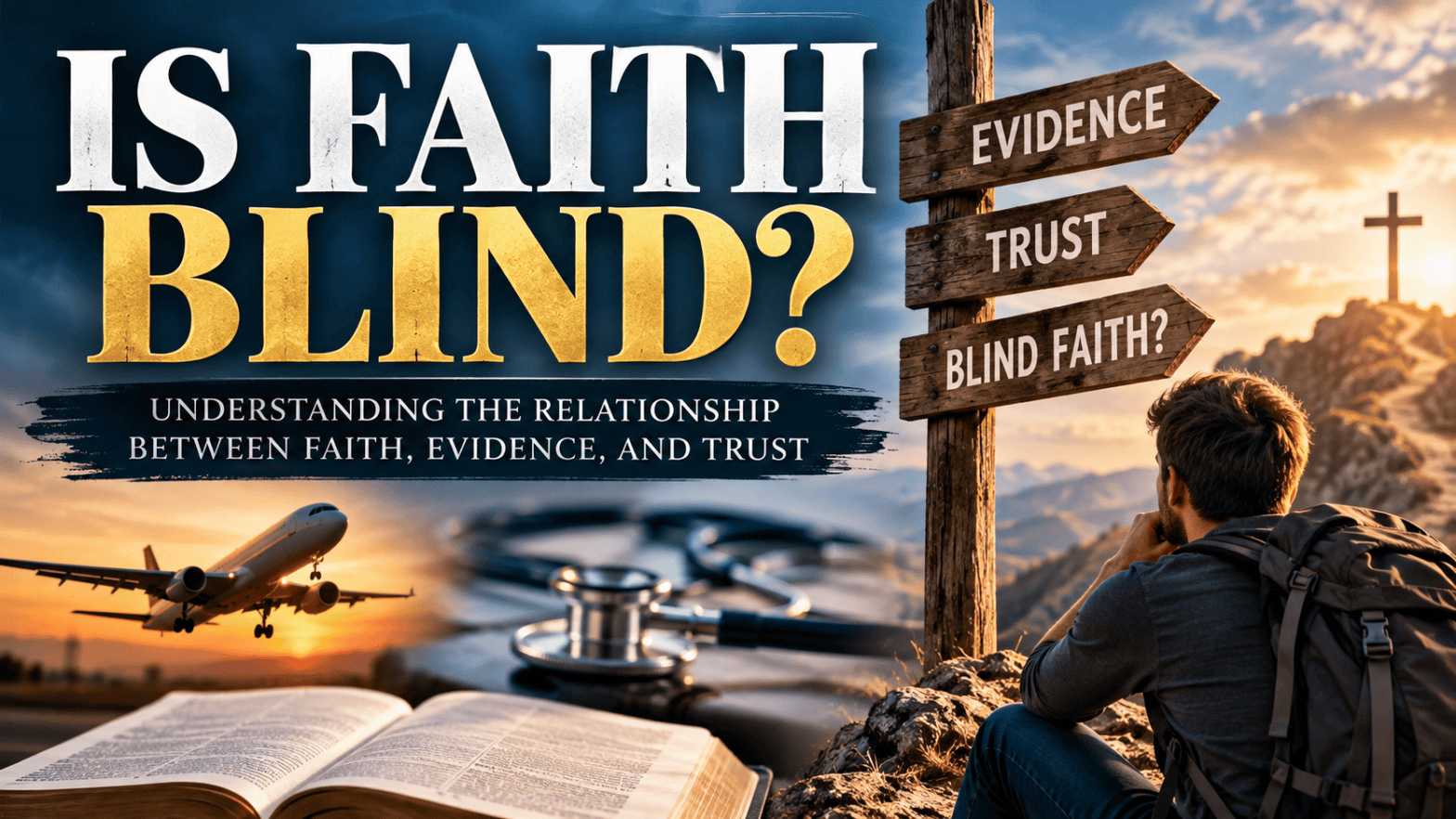
One of the most common criticisms of Christianity is that it requires blind faith.
The argument usually goes something like this: Christians believe in God without seeing Him, without being able to scientifically prove His existence, and without having the kind of evidence that would convince everyone. Therefore, Christianity must be based on blind faith rather than reason.
However, this criticism misunderstands what faith actually is.
Faith is not the absence of evidence. Faith is not the abandonment of reason. And faith certainly does not require someone to believe something regardless of what the evidence suggests.
In fact, we exercise faith and trust in ordinary life every single day. We make decisions based on evidence, experience, testimony, and reasonable expectations. We routinely place our confidence, or faith, in things we cannot personally verify with absolute certainty.
Christian faith is not fundamentally different in this respect. The question is not whether faith involves trust, but whether that trust is reasonably grounded.
1. What Exactly Is Faith?
Before discussing whether faith is blind, we should establish what faith actually means.
Faith and trust are closely related concepts. To have faith in someone or something is, in many contexts, to place trust or confidence in it. Trust involves relying on someone or something based on what we believe about its reliability.
They are not necessarily interchangeable in every theological or philosophical context, but they are deeply connected.
Consider Hebrews 11:1:
Now faith is the assurance of things hoped for, the conviction of things not seen. (Hebrews 11:1)
Notice that this verse does not describe faith as believing something without reason. It describes faith as assurance and conviction concerning things that are not presently visible.
There is an important distinction between something being unseen and something being unsupported.
For example, nobody has personally watched every historical event that has ever occurred. We believe many things about the past because of historical records, eyewitness testimony, archaeological discoveries, and other forms of evidence.
We cannot physically see the past, but that does not mean believing in it is irrational.
Likewise, the fact that God is not physically visible to us does not automatically make belief in Him irrational.
Christianity makes claims that can be examined through philosophy, history, eyewitness testimony, and the evidence surrounding the resurrection of Jesus Christ.
Faith involves trusting what we have good reason to believe is true.
2. Everyone Exercises Faith Every Day
One of the easiest ways to understand faith is to examine our everyday lives.
Consider a few examples.
Driving a car:
When you get into your vehicle, you trust that the brakes will work, the tires will hold, the engine will operate, and the other drivers will generally follow traffic laws.
Have you personally inspected every component of your vehicle? Have you independently verified the manufacturing process of every part? Have you personally tested the engineering behind your brakes?
I’m guessing not.
You rely on the expertise of engineers, manufacturers, mechanics, safety testing, and your previous experiences.
Your trust is not completely without evidence. It is based on a reasonable foundation.
Getting on an airplane:
When you board an airplane, you are trusting the pilots, maintenance crews, engineers, air traffic controllers, and safety procedures.
You do not personally inspect the engines before takeoff. You do not independently verify the qualifications of every person responsible for your flight.
Instead, you rely on evidence of the aviation industry’s reliability, established procedures, and the expertise of others.
You are placing your faith in something you cannot personally verify in its entirety.
Going to the doctor:
When you visit a physician, you generally trust that the doctor has the necessary education, training, and expertise to diagnose and treat you.
You may not understand the medical research behind your diagnosis or personally know how every medication works.
Yet, you reasonably trust the physician based on credentials, experience, medical research, and the reliability of the medical profession.
Using technology:
When you send a message through your phone, you trust that the message will reach its intended recipient.
You probably have no idea how every component of your phone, cellular network, internet infrastructure, or software operates.
Yet you faithfully use these systems because you have accumulated evidence that they generally work.
These examples demonstrate something important: human beings constantly make decisions based on faith that extends beyond what they can personally observe or independently verify.
We do not consider this irrational. We recognize that trust can be reasonable when it is supported by sufficient evidence.
Christian faith operates on the same basic principle.
3. Faith Exists on a Spectrum Depending on the Evidence
Not all faith is equally reasonable.
This is an important distinction because simply having faith in something does not automatically make that belief justified.
Faith can be reasonable, unreasonable, or even completely blind depending on the evidence supporting it.
Consider three examples.
Reasonable faith:
Imagine a person who has flown on airplanes dozens of times without incident. They understand that aircrafts undergo extensive safety inspections, are maintained by trained professionals, and are operated by qualified pilots.
They have substantial evidence supporting their faith in aviation.
When they board another airplane, their trust is reasonable.
Poor faith:
Now imagine someone who repeatedly ignores warning signs that their vehicle’s brakes are failing.
A mechanic tells them the brakes are dangerously damaged. They experience the brakes malfunctioning themselves, but they continue driving because they simply believe everything will be fine.
This is not particularly admirable faith. It is unreasonable confidence in spite of substantial contrary evidence.
Their trust is poorly placed because they are disregarding information that should change their judgment.
Blind faith:
Finally, imagine someone who believes a complete stranger is trustworthy simply because the stranger tells them so.
They have no history with this person, no references, no evidence of reliability, and no reasonable basis for their confidence.
They simply believe without sufficient justification.
That would be a rough example of blind faith.
The point is that faith itself is not necessarily good or bad. What matters is whether the object of our faith is worthy of trust and whether our confidence is proportionate to the evidence.
A person can have strong faith for good reasons, weak faith despite substantial evidence, or blind faith without any evidence.
This distinction is essential when discussing Christianity.
4. Christianity Does Not Teach Blind Faith
Contrary to the popular misconception, Christianity does not instruct believers to abandon reason or accept religious claims without examination.
In fact, Scripture repeatedly encourages people to examine, understand, and defend what they believe.
Consider the following passages:
John 20:30–31:
Now Jesus did many other signs in the presence of the disciples, which are not written in this book; but these are written so that you may believe that Jesus is the Christ, the Son of God, and that by believing you may have life in his name. (John 20:30–31)
John explicitly explains that he recorded evidence of Jesus’ works so that people might believe.
The purpose of his Gospel is not to encourage belief without evidence. He presents testimony about the signs Jesus performed to establish the truth of His identity.
1 Peter 3:15:
but in your hearts honor Christ the Lord as holy, always being prepared to make a defense to anyone who asks you for a reason for the hope that is in you; yet do it with gentleness and respect, (1 Peter 3:15)
Peter does not tell Christians to respond to challenges by saying they simply believe without explanation.
He tells them to be prepared to provide a reason for their hope.
Christianity is not afraid of examination. Believers should be able to explain why they believe what they believe.
Acts 17:2–3:
And Paul went in, as was his custom, and on three Sabbath days he reasoned with them from the Scriptures, explaining and proving that it was necessary for the Christ to suffer and to rise from the dead, and saying, “This Jesus, whom I proclaim to you, is the Christ.” (Acts 17:2–3)
Paul regularly reasoned with people from the Scriptures, explaining and proving that it was necessary for the Christ to suffer and rise from the dead.
This is particularly interesting because Paul did not approach everyone by demanding unquestioning acceptance. He reasoned with them, explained the Scriptures, and presented arguments.
1 Thessalonians 5:21:
but test everything; hold fast what is good. (1 Thessalonians 5:21)
This is a direct encouragement to examine claims rather than blindly accept everything presented to us.
Taken together, these passages demonstrate that Christianity is not opposed to reason, investigation, or evidence.
5. The Resurrection: An Example of Faith Grounded in Historical Evidence
Christianity is not simply a collection of moral teachings or philosophical ideas.
It makes a historical claim: Jesus Christ physically rose from the dead.
This is significant because Christianity itself identifies the resurrection as the foundation of the faith.
Paul writes:
And if Christ has not been raised, your faith is futile and you are still in your sins. (1 Corinthians 15:17)
Notice the implications.
Paul does not tell Christians that it makes no difference whether the resurrection actually happened. He does not suggest that Christianity remains equally true even if Jesus stayed dead.
Instead, he stakes the entire Christian faith on the truth of the resurrection.
In 1 Corinthians 15:3–8, Paul presents an early summary of the Christian proclamation, including Jesus’ death, burial, resurrection, and appearances to witnesses.
The passage identifies individuals and groups who claimed to have encountered the risen Christ.
This gives us historical material to examine.
We can investigate questions such as:
- Was Jesus a historical person?
- Was He crucified under Pontius Pilate?
- Did His earliest followers sincerely believe He had risen?
- How early was the resurrection proclamation being preached?
- What best explains the transformation of the disciples?
- What best explains the origins of Christianity?
These questions do not automatically settle every theological issue, but they demonstrate that Christianity makes claims that can be investigated.
The Christian does not need to pretend that historical evidence provides mathematical certainty. Historical reasoning works by examining testimony, sources, context, explanatory power, and competing explanations.
The resurrection is a historical claim supported by a cumulative case of evidence, not an invitation to believe something simply because someone says so.
Faith enters when we place our trust in the truth of what the evidence supports.
6. Faith Does Not Require Absolute Certainty
Another misunderstanding is the assumption that unless something can be demonstrated with absolute certainty, believing it must be irrational.
But this is not how we approach most areas of life.
We cannot prove with absolute philosophical certainty that our memories are real, that the external world exists independently of our minds, or that other people have conscious experiences similar to ours.
And still, we have excellent reasons to believe these things.
Most of our knowledge involves reasonable confidence rather than absolute certainty.
The same principle applies to historical knowledge, scientific conclusions, personal relationships, and everyday decisions.
There is a difference between saying something is absolutely certain and saying there are sufficient reasons to believe it.
Christianity does not require someone to possess omniscience before placing their trust in God.
Faith is not the claim that we have every answer. It is confidence in the One whom we have reason to believe is trustworthy.
In fact, trust would be unnecessary if we possessed absolute knowledge of every possible outcome.
7. Faith Is Not “Believing Despite the Evidence”, It Is Trusting Because of It
Ultimately, the Christian understanding of faith is much closer to trust than to blind speculation.
Think about a relationship with a close friend or spouse.
You trust that person because of their demonstrated character, their history of keeping promises, their honesty, and the relationship you have developed.
You cannot independently verify everything they do, or guarantee every future decision they will make.
Yet you have reasons to trust them.
The same principle applies to our relationship with God, although God is infinitely greater than any human relationship.
Christians place their trust in God because of His revealed character, His promises, the testimony of Scripture, the historical evidence, and the work of Christ throughout salvation history.
Hebrews 11 provides numerous examples of individuals who trusted God and acted upon His promises.
Abraham trusted God and left his homeland. Noah trusted God and built the ark. Moses trusted God and chose to identify with His people.
Their faith was not merely intellectual agreement. It involved trusting God enough to act upon what He had revealed.
That is what makes biblical faith more than simply acknowledging that God exists.
It is believing Him, trusting Him, and living in accordance with that trust.
Faith is not inherently blind, irrational, or opposed to evidence. It is a fundamental part of how human beings navigate the world.
We trust pilots, physicians, engineers, friends, family members, historical records, and countless systems every day. We do so because we have reasons to believe they are reliable, even when we cannot personally verify every detail.
The real issue has never been whether we exercise faith. We all do.
The more important question is whether our faith is reasonably grounded and whether the object of our trust is worthy of it.
Christianity does not ask us to close our eyes, abandon reason, or believe regardless of the evidence. It invites us to examine the claims of Christ, consider the testimony of Scripture, investigate the historical evidence, and ultimately place our trust in Him.
Faith is not believing something for no reason.
Faith is trusting someone because we have good reason to believe they are trustworthy.
And ultimately, the Christian faith is not about placing blind confidence in an unknown God. It is about placing our confidence in the God who has revealed Himself through Jesus Christ.
So as Cliffe Knechtle would say, “What are you putting your faith in, and what is the evidence that it is more reliable than Jesus Christ?”

Click the Image to
Get Your FREE Christian Apologetic Starter Pack
Study the Bible Deeper
• If you’re serious about growing in your understanding of Scripture, I highly encourage you to try Logos Bible Software—you can start with a free trial and see how it transforms your study time. — FREE TRIAL
• And for solid, biblically sound books and resources, take a look at ChristianBook.com—a great place to build your library. — CLICK HERE
Discover more from Mathetes Mission
Subscribe to get the latest posts sent to your email.


