
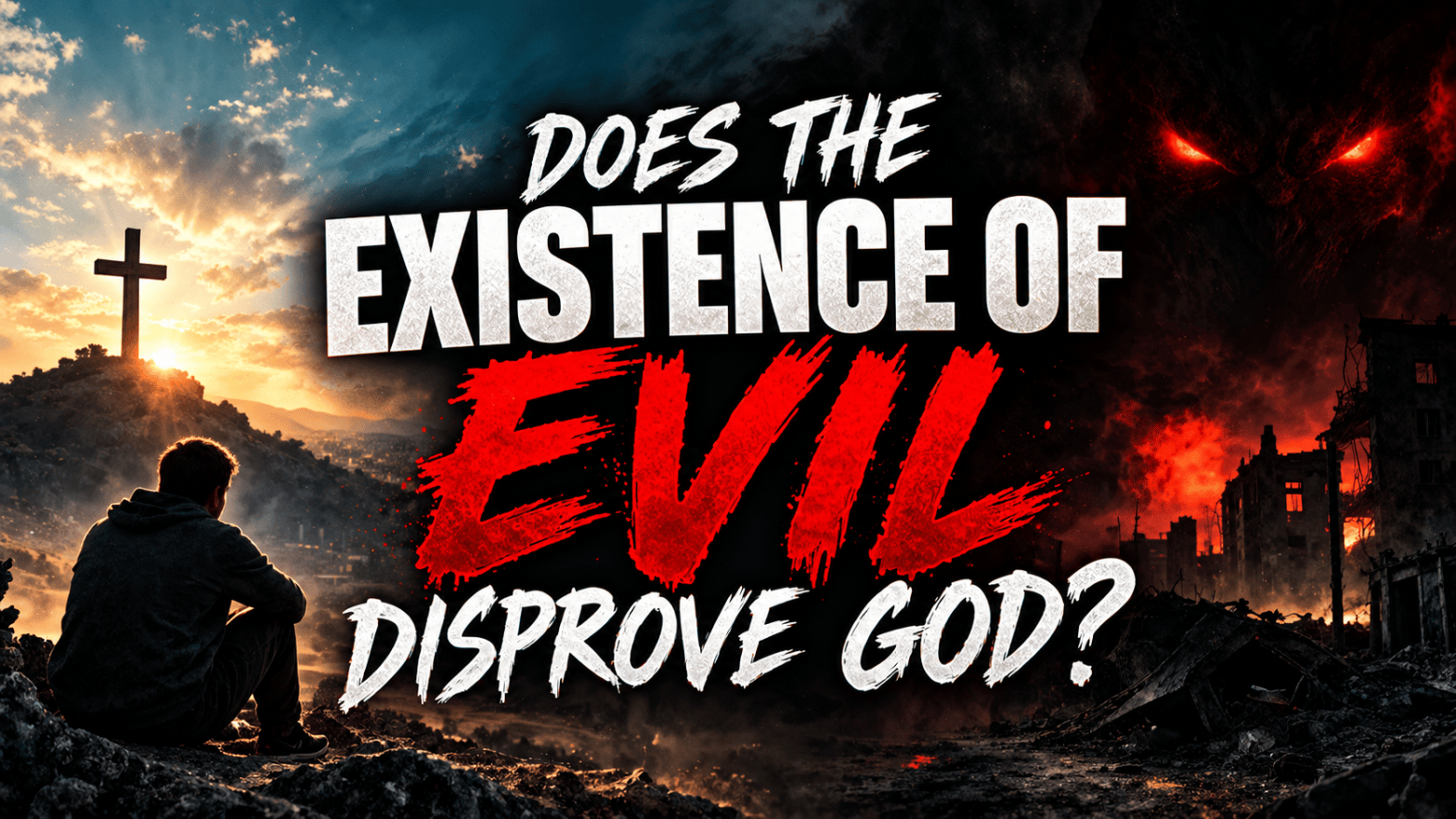
Few objections to Christianity are more emotionally powerful than the problem of evil.
If God is all-powerful, all-knowing, and perfectly good, why does evil exist?
Why do children suffer? Why do people get cancer? Why do wars happen? Why are innocent people murdered? Why do natural disasters destroy entire communities?
These aren’t merely philosophical questions. They are questions people ask through tears.
And Christians shouldn’t respond to them as though suffering were merely an intellectual puzzle.
The existence of evil is one of the most serious objections raised against belief in God. But does evil actually disprove God?
No.
In fact, Christianity provides a framework that makes sense of both the reality of evil and our deep conviction that evil is genuinely wrong.
The Argument from Evil
The basic argument can be summarized like this:
- If an all-powerful and perfectly good God exists, He would want to eliminate evil.
- If He is all-powerful, He would be able to eliminate evil.
- Evil exists.
- Therefore, an all-powerful and perfectly good God does not exist.
At first glance, this can seem devastating.
But there’s an important question hidden inside the argument:
Does God have morally sufficient reasons for allowing evil to exist temporarily?
If it’s possible that God has a morally sufficient reason for permitting evil, then the existence of evil does not logically contradict God’s existence.
Philosophers commonly distinguish between the logical problem of evil—the claim that God and evil are logically incompatible—and the evidential problem of evil, which argues that the amount or apparent randomness of suffering makes God’s existence unlikely.
Christian philosophers such as Alvin Plantinga have extensively argued against the claim that God’s existence and evil are logically incompatible. Contemporary philosophy of religion continues to distinguish these different forms of the argument. (Stanford Encyclopedia of Philosophy)
That distinction matters.
Because saying, “I can’t see why God would allow this” is not the same as proving “God can’t possibly have a good reason for allowing this.”
Christianity Doesn’t Call Evil Good
But here’s another important point.
Christianity doesn’t solve the problem of evil by redefining evil as something good.
The Bible calls evil what it is.
- Murder is evil.
- Hatred is evil.
- Abuse is evil.
- Injustice is evil.
- Sin is evil.
And God Himself is perfectly good.
James writes:
Let no one say when he is tempted, “I am being tempted by God,” for God cannot be tempted with evil, and he himself tempts no one. (James 1:13)
The Bible never portrays God as morally corrupt or as the author of sin.
At the same time, Scripture teaches that God is sovereign over His creation.
Those truths must be held together:
God is sovereign, and God is good.
The Bible doesn’t resolve the tension by sacrificing either truth.
The Fall Changed Everything
The Christian explanation begins with Genesis.
God’s original creation is repeatedly described as good. Humanity was created to know God and live in fellowship with Him.
But humanity rebelled.
Genesis 3 describes Adam and Eve’s disobedience, followed by alienation from God, pain, death, and the curse upon creation. (ESV Bible)
Paul later describes creation as being subjected to “futility” and says that creation is presently “groaning.”
For we know that the whole creation has been groaning together in the pains of childbirth until now. (Romans 8:22)
Christianity therefore doesn’t teach that the world is exactly as God intended it to remain forever.
We live in a fallen world.
Human sin produces enormous amounts of suffering. People lie, murder, exploit, abuse, oppress, steal, and wage war.
And much of what we call natural evil—disease, death, natural disasters, and suffering—is part of a creation that Scripture describes as presently subjected to corruption and futility.
The Bible’s explanation isn’t that God doesn’t care.
It is that something has gone profoundly wrong with creation—and God intends to put it right.
But What About Free Will?
One significant Christian response to moral evil concerns human freedom.
If God created human beings with genuine moral agency, then meaningful human choices include the possibility of choosing evil.
Love, obedience, courage, generosity, repentance, and faithfulness are meaningful precisely because human beings aren’t merely programmed machines.
This doesn’t mean that every instance of suffering can simply be explained by saying, “Someone had free will.”
That would be far too simplistic.
Free will can help explain moral evil—evil committed by moral agents—but it doesn’t by itself explain every disease, earthquake, or tragedy.
Christian philosophers therefore treat free will as one part of a broader response rather than a complete explanation of every instance of suffering. (Stanford Encyclopedia of Philosophy)
God Can Bring Good Out of Evil
One of Christianity’s most profound claims is that God can bring good purposes out of things that are genuinely evil.
Joseph’s brothers sold him into slavery.
Their actions were wicked.
Yet years later Joseph could say:
As for you, you meant evil against me, but God meant it for good, to bring it about that many people should be kept alive, as they are today. (Genesis 50:20)
Notice what Joseph did not say.
He didn’t say:
“Selling me into slavery wasn’t actually evil.”
He said that God was sovereign enough to accomplish good through something that others intended for evil.
That distinction is crucial.
Christianity does not require us to call evil good.
It tells us that God is powerful enough to overcome evil without Himself becoming evil.
The Cross Is the Ultimate Example
And this brings us to the center of Christianity.
The greatest evil ever committed was the unjust execution of the perfectly innocent Son of God.
Jesus was betrayed, falsely accused, beaten, crucified, and killed.
Yet the cross was not God’s failure.
It was God’s plan of redemption.
Human beings acted wickedly, while God simultaneously accomplished salvation through the very event that appeared to be defeat.
The cross therefore gives Christians something far greater than an abstract philosophical answer.
God entered into human suffering.
Christianity doesn’t teach that God watches suffering from a safe distance.
In Jesus Christ, God the Son took on human flesh and experienced rejection, pain, injustice, torture, and death.
The Christian God is not indifferent to suffering.
He came into it.
And He conquered death from within it.
“But Why Doesn’t God Just End Evil Right Now?”
This is where we need humility.
We should be careful not to claim that we know God’s specific reason for every tragedy.
Sometimes Christians say things like:
“God allowed that tragedy because He wanted to teach someone X.”
We should be cautious.
We usually don’t know why God permitted a particular event.
The book of Job is a powerful reminder of this. Job suffers tremendously, yet he is never given the heavenly explanation that the reader receives at the beginning of the book.
Scripture gives us something better than an explanation for every individual tragedy:
It gives us God’s character and His promise.
God is good.
God is sovereign.
God is just.
God is faithful.
And God has promised that evil and death will not have the final word.
Evil Will Not Have the Final Word
Romans 8 doesn’t end with suffering.
It ends with hope.
Paul says that creation is groaning while Christians wait for the redemption of their bodies. He then declares:
And we know that for those who love God all things work together for good, for those who are called according to his purpose. (Romans 8:28)
That doesn’t mean everything that happens is good.
Cancer isn’t good.
Murder isn’t good.
Abuse isn’t good.
Death isn’t good.
Romans 8:28 means that God is able to work all things toward His ultimate good purpose.
And Christianity ultimately points forward to the day when God will finally remove evil and suffering.
Revelation 21 describes the future restoration:
He will wipe away every tear from their eyes, and death shall be no more, neither shall there be mourning, nor crying, nor pain anymore, for the former things have passed away.” (Revelation 21:4)
That’s the Christian takeaway.
Not that suffering doesn’t matter.
Not that evil isn’t real.
Not that we should simply accept injustice.
But that evil is temporary, while God’s kingdom is eternal.
Does Evil Disprove God?
The existence of evil creates a serious philosophical and theological question.
But it doesn’t logically disprove the existence of God.
More importantly, Christianity provides a comprehensive explanation for why evil is objectively wrong, why humanity experiences alienation and corruption, why creation groans, why God can sovereignly work through evil without being evil Himself, and why evil will ultimately be defeated.
We Christian’s don’t have to pretend to understand every reason God permits every tragedy.
We can acknowledge:
“I don’t know why God allowed this.”
And still say:
“I know God is good.”
Because our confidence isn’t ultimately based on our ability to explain every event.
It’s based on what God has revealed about Himself.
And nowhere is His character more clearly revealed than at the cross.
The world contains suffering.
The world contains evil.
But Christianity declares that evil does not have the final word.
Jesus does.
And the same Christ who entered our suffering, died for sinners, and rose from the grave promises that one day He will make all things new.
Until then, Christians grieve.
We pray.
We oppose injustice.
We love those who suffer.
We proclaim the gospel.
And we wait in faith.
Because the existence of evil doesn’t mean God has abandoned His creation.
It means we are living in a world that is desperately in need of redemption—and Christianity declares that redemption has already begun in Jesus Christ.

Click the Image to
Get Your FREE Christian Apologetic Starter Pack
Study the Bible Deeper
• If you’re serious about growing in your understanding of Scripture, I highly encourage you to try Logos Bible Software—you can start with a free trial and see how it transforms your study time. — FREE TRIAL
• And for solid, biblically sound books and resources, take a look at ChristianBook.com—a great place to build your library. — CLICK HERE
Discover more from Mathetes Mission
Subscribe to get the latest posts sent to your email.


