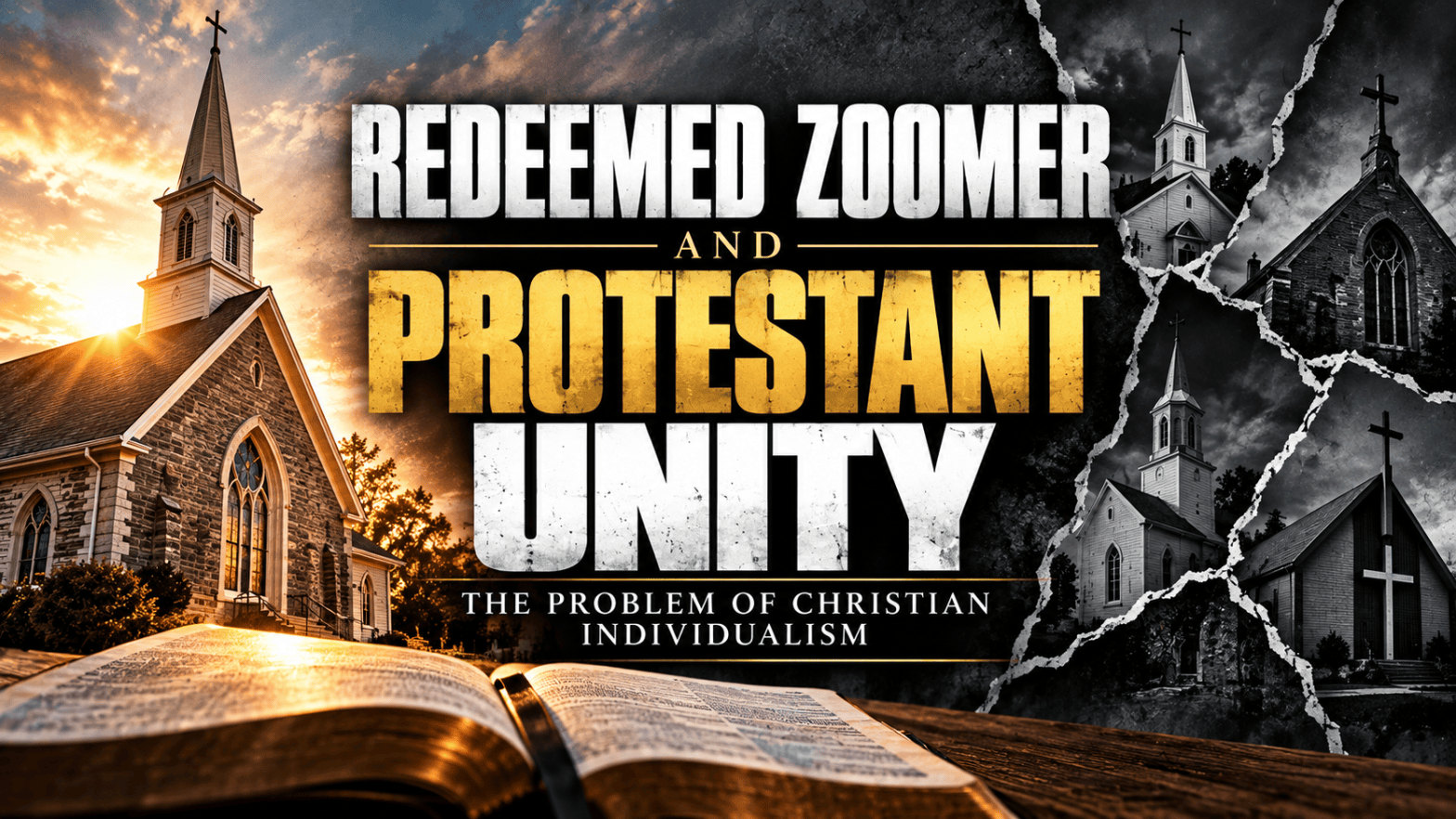
Why recovering the historic Protestant churches and resisting unnecessary division may be essential to the future of Christianity in America.
A Church Divided Against Itself
American Christianity has a problem that we do not always want to acknowledge: we have become remarkably good at starting new churches, denominations, ministries, and movements, but considerably less successful at demonstrating the visible unity of the body of Christ.
When Christians disagree, our first instinct is often to leave.
If we dislike the pastor, we find another congregation. If we disagree with the denomination, we establish a new one. If the worship style is not to our liking, we search for a church that better suits our preferences. And if a church’s culture does not align with our expectations, we can sometimes convince ourselves that the most faithful course of action is to start over somewhere else.
Of course, not every departure is wrong. There can be legitimate reasons to leave a church, particularly when it abandons essential Christian doctrine, tolerates serious unrepentant sin, or refuses to correct spiritual abuse. But where do we draw the line.
The Protestant Reformation itself demonstrates that institutional loyalty cannot be placed above fidelity to the Word of God.
Nevertheless, we should ask ourselves a difficult question: Have we become so accustomed to dividing that we have forgotten how to pursue unity?
This is one reason the Redeemed Zoomer movement deserves serious consideration.
Its effort to restore historic, confessionally grounded Christianity within America’s established mainline Protestant denominations raises an important question for the entire Christian community: What would happen if more Christians devoted themselves to reforming existing institutions rather than continually building new ones?
The answer could have significant implications for Protestantism’s theological credibility, historical continuity, cultural influence, and witness to the world.
1. What Is Redeemed Zoomer Trying to Accomplish?
Redeemed Zoomer is a Protestant Presbyterian Christian online creator and movement associated with the effort to revitalize historic Protestant denominations, particularly their traditional theological identity. Rather than simply encouraging conservative Christians to abandon mainline Protestant institutions, the movement advocates working to restore their historic Christian convictions from within.
Its Operation Reconquista initiative expresses this ambition: encouraging a return to orthodox Christian belief in denominations whose historic confessions and traditions remain important to their identity.
These include institutions such as the Presbyterian Church (PCUSA), the Episcopal Church, and the United Methodist Church, among others. The movement’s approach is particularly concerned with the relationship between Protestantism’s historic institutions and the theological convictions those institutions were originally established to preserve. See the discussions with Redeemed Zoomer on Truth Unites and The Aaron Renn Show.
The central idea is straightforward: instead of automatically abandoning historic Protestant denominations when they drift from their theological foundations, Christians should consider whether those institutions can be reformed.
This matters because historic Protestantism is not merely a collection of individual theological opinions. It has traditions of worship, confessions of faith, church governance, educational institutions, seminaries, congregations, and centuries of accumulated Christian thought.
When a denomination loses its commitment to its historic beliefs, the consequences extend beyond a disagreement over doctrine. It can also mean losing the institutional connection between contemporary Christians and generations of believers who worshiped, taught, served, donated time and money, and built churches before them.
Redeemed Zoomer argues that these institutions are worth fighting for.
That does not mean every mainline denomination is equally healthy, every historic congregation is doctrinally sound, or every attempted reform will succeed. Rather, the movement challenges the assumption that the only appropriate response to institutional decline is separation.
And that challenge deserves our attention.
2. The Protestant Reformers Did Not Believe Christianity Was Merely an Individual Experience
One of the most important aspects of this discussion is the distinction between personal faith and individualistic religion.
Christianity absolutely requires personal faith. No one can repent on our behalf, believe on our behalf, or substitute another person’s relationship with Christ for our own. Yet Scripture never presents Christianity as an invitation to pursue Jesus while treating His Church as optional.
Consider the apostle Paul’s description of the Church:
Now you are the body of Christ and individually members of it. (1 Corinthians 12:27, ESV)
Paul does not describe Christians as isolated individuals who happen to share similar beliefs. He describes them as members of one body, united under one Lord and dependent upon one another.
In 1 Corinthians 12:12–26, he explains that the body has many members with different functions. No member can legitimately declare that it has no need of the others.
Likewise, Ephesians 4:1–16 calls Christians to maintain the unity of the Spirit, grow into maturity, and build up the body of Christ together.
This is an institutional and communal vision of Christianity.
Believers gather, receive teaching, participate in the ordinances, exercise spiritual gifts, submit to appropriate leadership, and serve one another.
The Protestant Reformers understood this.
The Westminster Confession of Faith, adopted in 1647, devotes an entire chapter to the Church. Chapter 25 distinguishes the invisible Church (the whole company of God’s elect) from the visible Church, consisting of those throughout the world who profess the true religion and their children. It describes the visible Church as Christ’s kingdom and God’s household, entrusted with the ministry, Scriptures, and ordinances for the gathering and spiritual growth of believers.
The confession also acknowledges that particular churches differ in their purity and that even the purest churches remain subject to error. In other words, the Reformers understood both the importance of the visible Church and the reality of institutional imperfection. Read Westminster Confession of Faith, Chapter 25.
The Belgic Confession of 1561 makes the point even more directly. Article 28 teaches that Christians ought to join themselves to the true Church, maintain its unity, submit to its instruction and discipline, and serve one another as members of the same body. It explicitly rejects the idea that believers should withdraw into an isolated religious existence. Read Belgic Confession, Article 28.
These are not the words of Christians who believed that personal conviction eliminated the need for an organized Church.
They believed that the Church was a divinely instituted community with a visible presence in the world.
The Reformation was not a rejection of the Church itself
This distinction is essential.
The Reformers did not simply conclude that organized religion was unnecessary and that Christians should each determine their own individualistic theology. They argued that the Church needed to be reformed according to Scripture.
They disagreed with Rome over authority, justification, the sacraments, and other important matters. Those disagreements were serious, and the resulting divisions cannot be reduced to mere personality conflicts or a preference for different worship styles.
Regardless, the Reformers sought to establish and preserve churches with recognizable doctrine, ordained ministry, corporate worship, and defined standards of belief.
The Reformation produced confessions, catechisms, seminaries, church orders, and enduring ecclesiastical institutions. The Westminster Standards, the Belgic Confession, the Heidelberg Catechism, and the Thirty-Nine Articles all testify to the institutional concept.
The Protestant principle of semper reformanda—often expressed as “always reforming”—is frequently misunderstood as permission to continually reinvent Christianity according to contemporary preferences.
Its proper application is the opposite: the Church must continually examine itself in light of God’s Word, correcting its errors and remaining faithful to the truth.
Reformation is not the same thing as perpetual reinvention.
If an institution has departed from its founding convictions, reform may require recovering what has been lost rather than inventing something new.
That is precisely the question Redeemed Zoomer places before Protestant Christians.
3. American Individualism Has Made Christian Unity More Difficult
Why is this so difficult to accomplish in America?
One significant reason is the influence of individualism on American religious culture.
American society places considerable value on personal autonomy, freedom of choice, independence, and self-determination. These values can serve legitimate purposes, especially when protecting conscience and preventing coercion. Yet they can also shape our expectations of the Church in unhealthy ways.
We begin to think of a congregation as something that exists primarily to meet our preferences.
We want the right preaching style, the right music, the right political atmosphere, the right social environment, and the right balance between tradition and innovation. When those preferences are not satisfied, we can be tempted to move on.
Church shopping is not inherently wrong. Christians should seek faithful teaching, sound doctrine, responsible leadership, and a healthy congregation. But there is a difference between seeking a faithful church and expecting a church to conform to every personal preference.
The first recognizes that we are accountable to Christ and called to grow within His body.
The second risks turning the Church into a religious consumer product with thousands of denominations and “off-shoots”…
This is where American individualism becomes spiritually dangerous. Instead of asking, “How can I faithfully serve Christ and His people in this congregation?” we may ask, “Does this congregation give me the experience I want?”
Instead of learning to live alongside Christians whose personalities, backgrounds, and preferences differ from ours, we search for a community in which we feel most comfortable.
Instead of working patiently to resolve disagreements, we sometimes treat disagreement itself as sufficient reason to leave.
Over time, this mentality creates a cycle of fragmentation. Churches divide, new congregations form, new denominations emerge, and Christians increasingly organize themselves into communities that reflect their existing preferences.
The result is not typically greater faithfulness.
Christianity calls us beyond ourselves
The New Testament repeatedly challenges the instinct to place personal preference above the needs of the community.
Philippians 2:3–4 commands believers to reject selfish ambition and consider the interests of others. Ephesians 4:2–3 calls Christians to exercise humility, patience, and forbearance while maintaining the unity of the Spirit. Romans 12:3–8 describes believers as members of one another, possessing different gifts that are meant to serve the whole body.
These passages do not require Christians to surrender their consciences or pretend that theological differences do not matter. They do, however, they challenge us to approach disagreements with humility.
Sometimes the most spiritually beneficial thing we can do is remain in a difficult but faithful community, work through disagreements, and learn to love people who do not share all our preferences.
Unity requires sacrifice.
It requires patience with imperfect people, submission to legitimate authority, willingness to be corrected, and a recognition that the Church does not belong to us.
It belongs to Jesus Christ.
4. Endless Schisms Weaken the Protestant Witness
Denominational diversity is not automatically sinful, although most schisms are. Christians have legitimate disagreements about baptism, church governance, the Lord’s Supper, spiritual gifts, and other theological matters. Some of these differences are substantial enough that distinct ecclesiastical traditions are understandable.
The problem is that Christians can become so comfortable with division that we stop treating it as something requiring serious theological justification.
Let’s consider the practical consequences…
First, division can weaken our public witness
Jesus prayed for the unity of His disciples in John 17:20–23, asking that they would be one so that the world might believe that the Father had sent Him.
Christ clearly regarded the unity of His followers as important to their witness.
When Christians publicly condemn one another over secondary issues, establish competing institutions out of personal frustration, or behave as though other faithful believers are enemies, we obscure the unity we are supposed to demonstrate.
Our disagreements often can become more visible than our shared confession of Jesus Christ.
That is a serious problem in a society where Christianity is already frequently misunderstood.
Second, fragmentation can squander resources
Every church requires people, money, leadership, facilities, educational resources, and years of sustained labor.
When Christians continually establish new institutions, they may duplicate administrative structures, divide limited financial resources, compete for the same members, and leave historic congregations struggling to survive.
Unnecessary duplication can prevent Christians from accomplishing together what would be difficult to accomplish separately.
Imagine what might be possible if more churches worked together to support theological education, train pastors, serve the poor, publish serious Christian scholarship, strengthen families, and reach people who have never heard the gospel.
Imagine the benefit of historic congregations retaining their buildings, archives, endowments, seminaries, and established presence in their communities while recovering a robust commitment to Christian orthodoxy.
Institutional continuity is not merely about preserving old buildings. It is about preserving and stewarding resources that can serve future generations.
Third, division can weaken historical continuity
Christianity is a faith rooted in history. We proclaim a real incarnation, a historical crucifixion, a bodily resurrection, and the continuing work of God through His people across generations.
Our faith is not something we invented yesterday.
Historic Protestant denominations can embody that continuity through their liturgies, confessions, church buildings, educational institutions, and accumulated theological traditions.
When orthodox Christians abandon these institutions entirely, they can unintentionally surrender their historic resources to other theological movements.
This is one of the concerns behind Redeemed Zoomer’s effort to revitalize the mainline churches.
The goal is not to preserve an institution merely because it is old. An institution that has abandoned the gospel should not receive unquestioning loyalty because of its history.
Rather, the goal is to recognize that faithful reform can preserve both theological conviction and historical continuity.
We should not assume that the only way to remain orthodox is to establish something new.
Sometimes the better course is to recover what already exists.
5. Why Redeeming the Mainline Matters
The term mainline Protestantism generally refers to historically established Protestant traditions in the United States, including denominations such as the Presbyterian Church, the Episcopal Church, the United Methodist Church, and the Evangelical Lutheran Church in America.
These bodies have complicated histories and differ considerably in theology, governance, and contemporary practice. Many have experienced substantial disputes over biblical authority, sexuality, ordination, and the interpretation of historic Christian doctrine.
The purpose of restoring orthodox Christianity within these institutions is not to pretend that those disputes are insignificant.
It is to ask whether Christ would want us to abandon them, or to seek unity and reformation.
For example, a denomination may retain a historic confession while struggling to ensure that its ministers and congregations actually teach in accordance with it. A church may possess an impressive history while experiencing theological drift. A congregation may have substantial resources but lack a clear commitment to the beliefs that originally shaped its identity.
In such cases, reform would mean more than adopting traditional aesthetics or returning to older worship practices.
It would require renewed commitment to Scripture, historic Christian doctrine, meaningful confessional standards, faithful preaching, responsible church discipline, and the formation of future pastors.
It would also require patient institutional work: joining congregations, developing relationships, supporting faithful leadership, participating in denominational processes, and working through established structures.
That is not glamorous work. It may take years, and it may fail.
But it offers an alternative to the assumption that every generation of orthodox Christians must abandon the institutions inherited from the previous one.
6. Unity Does Not Mean Compromise at Any Cost
At this point, an important qualification is necessary.
The pursuit of Christian unity must never become an excuse to abandon Christian truth.
Jesus did not pray for a unity detached from the truth of God’s Word. In John 17:17–19, He explicitly prayed for His disciples to be sanctified in the truth.
Paul likewise warned against false teaching and instructed the Church to maintain sound doctrine. In Galatians 1:6–9, he strongly condemned the proclamation of a different gospel. In Romans 16:17, he warned believers against those who cause divisions contrary to the teaching they had received.
Scripture therefore recognizes two different dangers: unnecessary division among faithful Christians and destructive unity with those who reject the gospel.
We must take both seriously.
A congregation that faithfully preaches the gospel but differs from us over a secondary matter should not automatically be treated as an enemy. Conversely, a church that denies essential Christian truth should not be regarded as faithful merely because it belongs to an ancient denomination or uses traditional liturgy.
The Protestant Reformers understood that distinction. They sought unity in the truth, not institutional uniformity at any price.
The Westminster Confession itself recognizes that churches vary in purity and that some can degenerate so far that they cease to be true churches of Christ. Its commitment to the visible Church did not require unconditional allegiance to every institution claiming the Christian name.
This provides an important framework for evaluating Redeemed Zoomer’s project.
Reforming an existing denomination is a worthy goal. But the legitimacy of that goal must be evaluated in light of Scripture, the denomination’s actual beliefs and practices, and the responsibilities of Christians to get involved.
The point is not to eliminate every denominational distinction. It is to stop treating division as the default response to every disagreement, and become united Christian’s once again.
7. What Would a More United Protestantism Look Like?
If American Protestants took these principles seriously, the result would not necessarily be a single denomination governing every Christian congregation, though I would love if we had one united Protestant church.
Instead, we might see a Protestantism that is more conscious of its shared heritage, more committed to historic Christian doctrine, and more willing to cooperate across denominational boundaries.
First, Christians would become better acquainted with the historic confessions of their own traditions. Baptists, Presbyterians, Anglicans, Lutherans, and other Protestants would have a clearer understanding of what their churches believe, why they believe it, and how those convictions relate to the broader Christian tradition.
Second, denominational leaders would take theological accountability seriously. Confessions would function as meaningful standards of belief rather than historical documents that can be ignored whenever they become inconvenient.
Third, Christians would learn to distinguish essential doctrines from secondary disagreements. We should be prepared to defend the deity of Christ, His bodily resurrection, the authority of Scripture, and the gospel of salvation while also recognizing that not every disagreement over church polity or sacramental practice should produce hostility.
Fourth, congregations would pursue practical cooperation wherever possible. Churches with different denominational identities can work together in evangelism, charitable service, apologetics, Christian education, and support for persecuted believers.
Finally, Christians would reconsider the assumption that institutional reform is less desirable than starting over.
A generation of believers committed to reforming churches, strengthening confessional identity, and preserving historical continuity could accomplish far more than a generation that assumes every problem requires a new institution.
Such a movement would require patience, humility, theological seriousness, and a willingness to sacrifice personal comfort for the long-term good of the Church.
It would also require Christians to recognize that they are not the first generation to wrestle with these problems.
We have inherited a faith, a body of believers, and a history of theological reflection that extends far beyond our own preferences and experiences.
We are stewards of that inheritance.
We Need Reformers, Not Just Founders
The Church is not a personal brand, a consumer product, or a collection of independent religious projects.
It is the body of Christ!
That truth should shape how we approach our congregations, our denominations, our disagreements, and our responsibilities to future generations.
The Redeemed Zoomer movement raises a challenge that extends well beyond the mainline Protestant churches: are we willing to invest in the difficult work of reforming existing Christian institutions, or have we become so accustomed to division that we can no longer imagine another way?
Faithfulness to Christ must come before loyalty to any denomination, tradition, pastor or institution.
But that principle should never become a convenient justification for unnecessary division or schism.
We should be slow to divide, eager to reconcile, serious about doctrine, and willing to work patiently for the health of the Church.
We should recognize that historic institutions can be reformed, that theological traditions can be recovered, and that Christian unity is worth pursuing even when doing so is difficult.
Most importantly, we should resist the temptation to make Christianity conform to our individual preferences.
The question is not merely whether we can find a church that suits us. The question is whether we are willing to become faithful members of Christ’s Church, serving alongside imperfect believers for the glory of God.
American Protestantism does not need another generation of Christians who are quick to start something new.
It needs a generation willing to recover what has been lost, preserve what remains faithful, and repair what has been broken.
It needs reformers who understand that the Church belongs to Christ—not to us.
And it needs Christians who remember that unity is not simply something we hope to experience in heaven. It is something we are commanded to pursue on earth.
Every time we schism and start our own new church, it’s a theological slap through time at all the millions of Christian that died to preserve the TRUTH we cherish
May we be faithful to the truth, humble in our disagreements, patient in our reforms, and united in our commitment to Jesus Christ.
For more information on Redeemed Zoomer and his initiative, I recommend checking out his channels and discussions on the matter. I have linked below ways to find him.
Operation Reconquista: https://redeemedzoomer.com/?page_id=143
YouTube: https://youtube.com/@redeemed_zoomer?si=XfyR5xVl2yC2woDd

Click the Image to
Get Your FREE Christian Apologetic Starter Pack
Study the Bible Deeper
• If you’re serious about growing in your understanding of Scripture, I highly encourage you to try Logos Bible Software—you can start with a free trial and see how it transforms your study time. — FREE TRIAL
• And for solid, biblically sound books and resources, take a look at ChristianBook.com—a great place to build your library. — CLICK HERE
Discover more from Mathetes Mission
Subscribe to get the latest posts sent to your email.


