
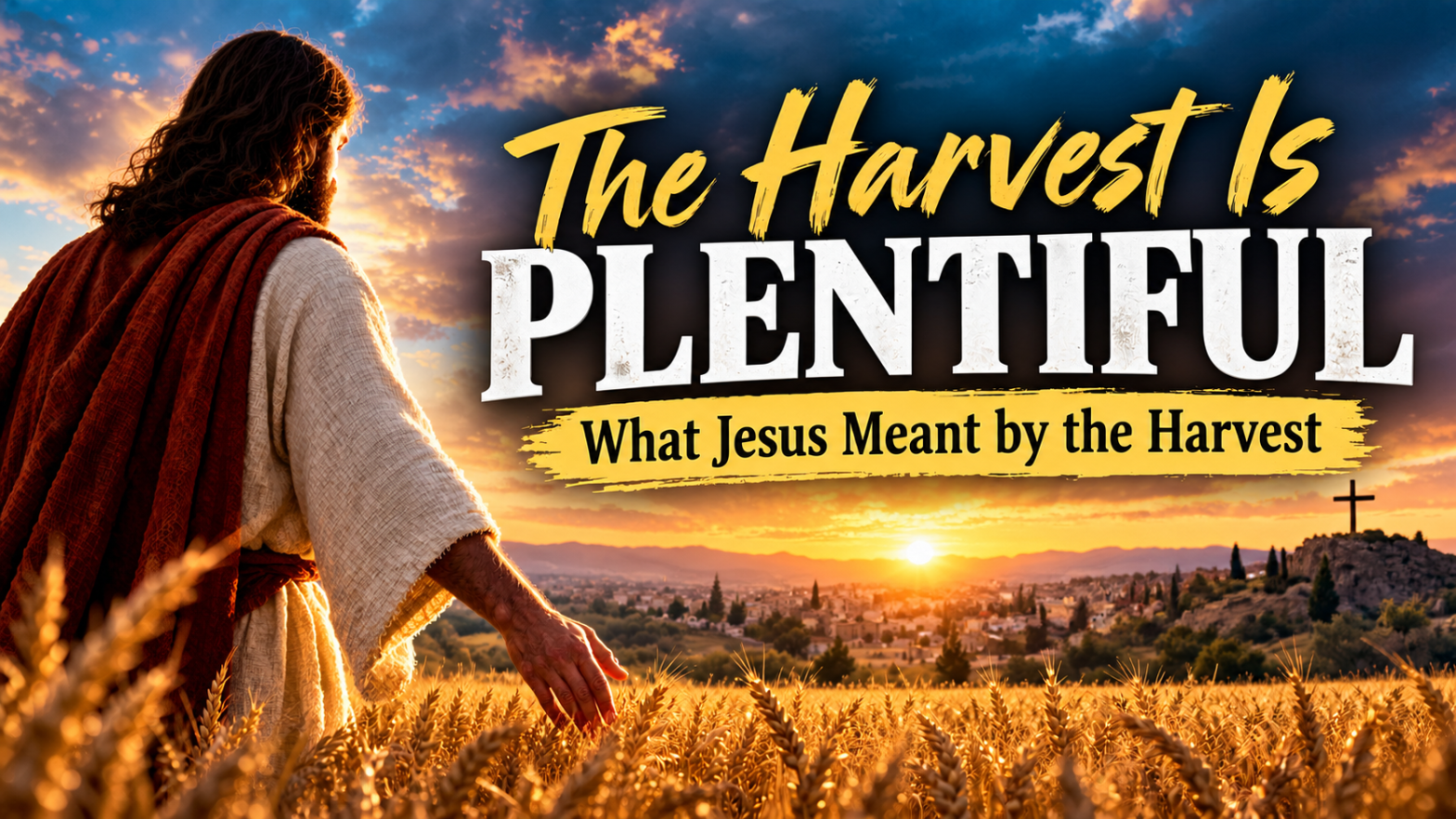
Every autumn, fields across the country remind us of something deeply familiar: harvest.
Crops that spent months growing are finally ready to be gathered. Farmers don’t plant simply to watch something grow. They plant with a purpose—the eventual harvest.
Jesus used this same imagery when teaching His disciples about something infinitely more important than an agricultural harvest: the mission of taking the gospel to people who need to hear it.
In Matthew 9, Jesus looked upon the crowds around Him and said:
37 Then he said to his disciples, “The harvest is plentiful, but the laborers are few; 38 therefore pray earnestly to the Lord of the harvest to send out laborers into his harvest.” (Matthew 9:37–38)
Jesus Saw the People
Before Jesus talked about the harvest, Matthew tells us what He was doing.
And Jesus went throughout all the cities and villages, teaching in their synagogues and proclaiming the gospel of the kingdom and healing every disease and every affliction. (Matthew 9:35)
Jesus wasn’t disconnected from the people around Him.
He went to them.
He taught them.
He proclaimed the gospel to them.
He cared about their physical suffering.
And He cared about their spiritual condition.
Then Matthew tells us:
When he saw the crowds, he had compassion for them, because they were harassed and helpless, like sheep without a shepherd. (Matthew 9:36)
This is where the harvest metaphor begins.
Jesus didn’t look at the crowds and see statistics.
He saw people.
People who were hurting.
People who were spiritually lost.
People who needed a shepherd.
People who needed the kingdom of God.
And His response was compassion.
The Harvest Is Plentiful
Jesus said:
“The harvest is plentiful…”
What did He mean?
In the immediate context, Jesus was looking at the crowds of people surrounding Him and describing them as a harvest ready to be gathered.
The imagery communicates opportunity.
There were many people who needed to hear the message of God’s kingdom.
There were many people who needed the gospel.
And there were comparatively few workers.
Jesus wasn’t telling His disciples to sit around waiting for people to magically come to them.
He was preparing them for mission.
The Harvest Belongs to God
Notice something else Jesus says:
“the Lord of the harvest”
The harvest doesn’t belong to us.
It belongs to God.
That matters tremendously for evangelism.
We are not responsible for saving people.
God is.
We can’t regenerate someone’s heart.
We can’t force someone to believe.
We can’t manufacture conversion through clever arguments or emotional pressure.
Our responsibility is to faithfully proclaim Christ.
Paul explains this beautifully in 1 Corinthians:
I planted, Apollos watered, but God gave the growth. (1 Corinthians 3:6)
Paul planted.
Apollos watered.
God gave the growth.
We Are Called to Work
The fact that God produces the growth doesn’t mean Christians are passive.
Jesus specifically speaks about laborers.
Farmers don’t harvest crops by standing in the field and hoping someone else does it.
There is work to be done.
Likewise, Christians have been given a mission.
Jesus’ final command to His disciples in Matthew 28 was:
19 Go therefore and make disciples of all nations, baptizing them in the name of the Father and of the Son and of the Holy Spirit, 20 teaching them to observe all that I have commanded you. And behold, I am with you always, to the end of the age.” (Matthew 28:19–20)
The church isn’t merely supposed to preserve the gospel for ourselves.
We’re supposed to proclaim it.
We’re called to make disciples.
We’re called to teach.
We’re called to bear witness to Jesus Christ.
Evangelism Isn’t Only for Pastors
Sometimes Christians hear the word evangelism and immediately picture a pastor preaching from a pulpit or a missionary standing in a foreign country.
Those are certainly forms of evangelism.
But the Great Commission wasn’t given merely to a professional class of Christians.
Every Christian is called to live as a witness to Christ.
That can happen in ordinary places.
- At work.
- At school.
- In your neighborhood.
- At the grocery store.
- Online.
- With friends.
- With family members.
- Through conversations.
- Through hospitality.
- Through acts of service.
And sometimes through simply being willing to answer someone’s question:
“Why do you believe that?”
Peter tells Christians:
but in your hearts honor Christ the Lord as holy, always being prepared to make a defense to anyone who asks you for a reason for the hope that is in you; yet do it with gentleness and respect, (1 Peter 3:15)
Character + readiness + explanation + respect
We’re supposed to live differently, be ready to speak, and know why we believe what we believe.

The Harvest Requires Laborers
Jesus didn’t say:
“The harvest is plentiful, but the harvesters are unnecessary.”
He said:
“the laborers are few”
That should make us stop and think.
There are billions of people in the world.
Every person we encounter has a story.
Every person carries questions.
Every person will eventually face death.
And every person needs the gospel.
That doesn’t mean we should become frantic or treat people like numbers.
Quite the opposite.
If Jesus looked at crowds and had compassion on them, then Christians should learn to see people the same way.
The person sitting next to you isn’t an interruption.
The difficult coworker isn’t merely an annoyance.
The stranger you pass isn’t merely background scenery.
They are a person made in the image of God.
And they need Christ.
Pray for Laborers
Jesus’ first command regarding the harvest is surprisingly simple:
Pray.
therefore pray earnestly to the Lord of the harvest to send out laborers into his harvest.” (Matthew 9:38)
Before Jesus tells His disciples to become evangelists, He tells them to pray.
That matters.
Evangelism should begin with dependence upon God.
- We can study apologetics.
- We can learn theology.
- We can improve our communication.
- We can memorize Scripture.
- We can become better conversationalists.
All of those things are valuable.
But none of them replaces prayer.
We need God to open doors.
We need God to prepare hearts.
And we need God to raise up more workers.
But Notice What Happens Next
There’s an interesting connection between Matthew 9 and Matthew 10.
Jesus says:
5 These twelve Jesus sent out, instructing them, “Go nowhere among the Gentiles and enter no town of the Samaritans, 6 but go rather to the lost sheep of the house of Israel. 7 And proclaim as you go, saying, ‘The kingdom of heaven is at hand.’ (Matthew 10:5–7)
Chapter 10 begins with Jesus sending His twelve disciples out.
The people praying for laborers were themselves sent as laborers.
That’s worth remembering.
Sometimes when we pray:
“Lord, send someone to reach these people,”
God’s answer may be:
“I am sending you.”
We shouldn’t pray for evangelistic opportunities while refusing to participate in them ourselves.
We shouldn’t pray for missionaries while refusing to support them.
We shouldn’t pray for our neighbors to hear the gospel while never being willing to talk to our neighbors.
Prayer and obedience belong together.
You Don’t Have to Know Everything
One reason Christians hesitate to evangelize is fear.
“What if they ask me something I don’t know?”
“What if they challenge Christianity?”
“What if I can’t answer?”
“What if I mess it up?”
Those concerns are understandable.
But remember:
You aren’t the Savior.
— Jesus is!
You don’t have to know the answer to every philosophical question before you can tell someone what Christ has done.
You can say:
“I don’t know, but I’d love to look into that with you.”
That’s not failure.
That’s honesty.
And perhaps that question becomes the beginning of a much deeper conversation.
At the same time, Christians should take seriously the command to grow in knowledge.
We should study Scripture.
We should learn theology.
We should understand the basic arguments for Christianity.
We should be prepared to answer objections.
But preparation should lead to mission—not replace it.

Every Seed Doesn’t Become a Harvest Immediately
Evangelism can sometimes feel discouraging.
You share the gospel, and nothing seems to happen.
You answer someone’s objections, and they still don’t believe.
You invite someone to church, and they decline.
You pray for someone for years, and nothing appears to change.
Don’t assume nothing is happening.
Paul’s agricultural analogy reminds us that gospel work can involve different stages.
One person plants.
Another waters.
God gives the growth.
You may never know what effect one conversation ultimately has.
Maybe you answered a question that someone remembers five years later.
Maybe a Scripture verse you shared stays with them.
Maybe your kindness removes one obstacle to their perception of Christianity.
Maybe someone else eventually explains the gospel to them.
You don’t control the harvest.
You are called to be faithful.
What Kind of Laborer Will You Be?
The harvest imagery of autumn can therefore remind us of something much deeper.
Fields don’t harvest themselves.
The gospel doesn’t proclaim itself.
People need to hear.
God has chosen to use His people as instruments through which the message of Christ is proclaimed.
That is an incredible privilege.
You don’t have to stand behind a pulpit.
You don’t have to travel across the world.
You don’t need thousands of followers.
You simply need to be faithful where God has placed you.
Start with the people already around you.
Pray for them.
Love them.
Listen to them.
Learn their questions.
Know your Bible.
Learn how to explain the gospel.
And when God opens the door, walk through it.
Study the Bible Deeper
• If you’re serious about growing in your understanding of Scripture, I highly encourage you to try Logos Bible Software—you can start with a free trial and see how it transforms your study time. — FREE TRIAL
• And for solid, biblically sound books and resources, take a look at ChristianBook.com—a great place to build your library. — CLICK HERE
Discover more from Mathetes Mission
Subscribe to get the latest posts sent to your email.


