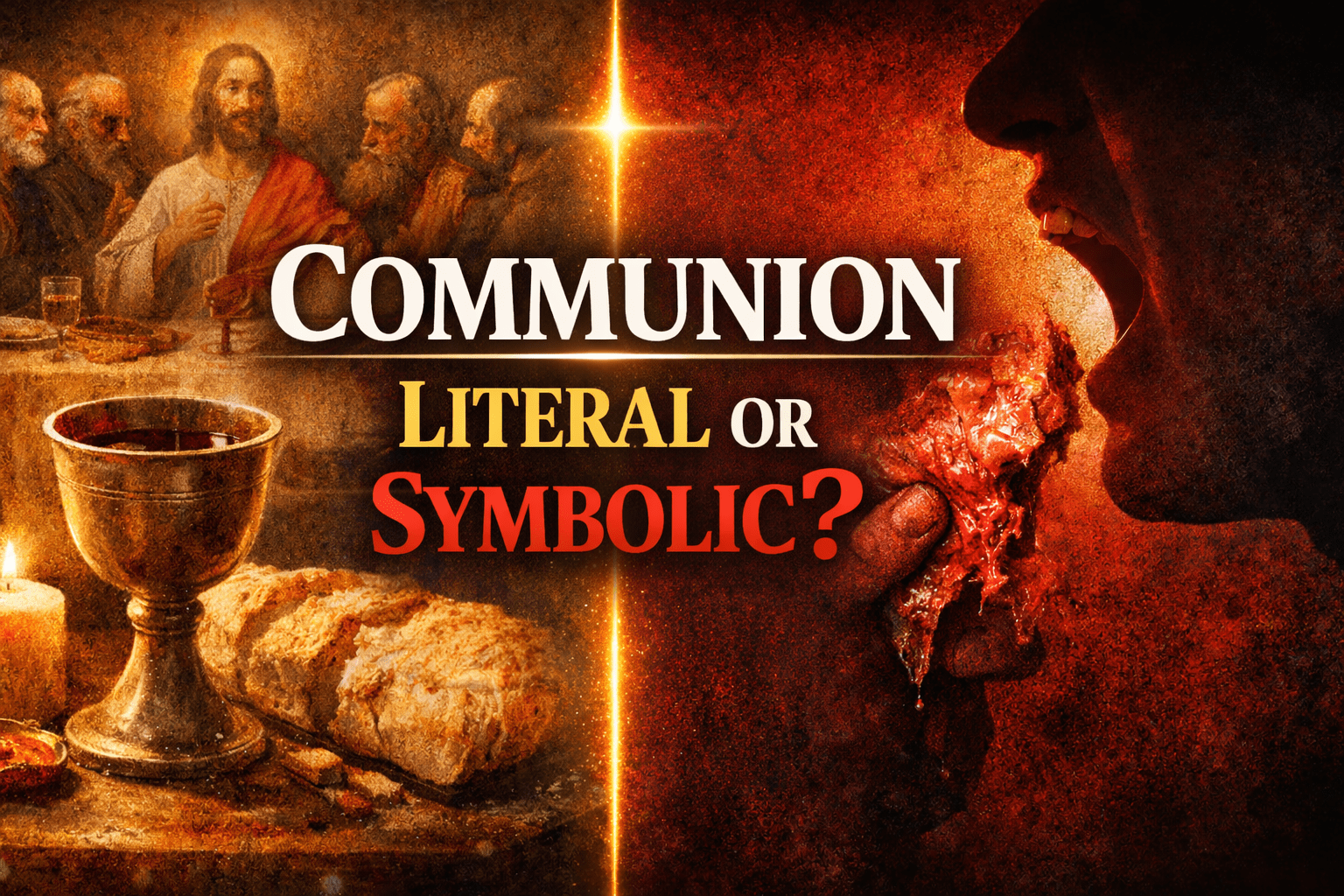
Few practices in Christianity carry as much theological weight as Communion, also called the Lord’s Supper or the Eucharist.
The questions surrounding it are significant:
What exactly did Jesus mean when He said, “This is my body” and “This is my blood”?
Did He intend believers to consume His literal body and blood in some mystical way, or was He establishing a symbolic memorial of His sacrifice?
Closely related to this debate is the question of frequency.
Should Communion be observed weekly, monthly, or yearly?
When the full biblical context is examined (especially the Passover background), the Greek language used in the New Testament, and the teaching of the Bread of Life discourse in the Gospel of John… a compelling case emerges that Communion functions primarily as a memorial remembrance of Christ’s sacrifice and that an annual observance aligns closely with the biblical pattern established in Passover.
This view does not diminish the significance of the Lord’s Supper. Instead, it highlights the powerful symbolism Jesus intentionally built into the meal and the profound theological meaning behind remembering His once-for-all sacrifice.
1. The Passover Foundation
To understand Communion, one must begin with Passover.
The Last Supper was not an ordinary meal but a Passover celebration rooted in Israel’s redemption from Egypt.
In Exodus 12, God commands Israel to sacrifice a lamb and mark their homes with its blood so that judgment would “pass over” them.
This event was not merely historical. It became a permanent annual memorial for centuries to come.
God instructed Israel:
This day shall be for you a memorial day, and you shall keep it as a feast to the Lord; throughout your generations, as a statute forever, you shall keep it as a feast. (Exodus 12:14)
The Passover meal contained symbolic elements:
- Unleavened bread (representing the haste of Israel’s departure)
- Bitter herbs (representing slavery)
- The sacrificial lamb (for the passing over of judgement)
- Cups of wine (representing covenant promises)
Each component symbolized aspects of Israel’s deliverance.
Importantly, no participant believed these elements literally became the historical events they represented. The meal functioned as a symbolic remembrance.
The New Testament explicitly identifies Christ with this Passover imagery.
In 1 Corinthians 5:7, Paul the Apostle writes:
“For Christ, our Passover lamb, has been sacrificed.”
If Jesus is the fulfillment of the Passover lamb, it is reasonable to conclude that the memorial connected to His sacrifice could follow the same annual rhythm that Passover had followed for centuries.
2. The Institution of the Lord’s Supper
During the Last Supper, Jesus took two elements from the Passover meal and gave them new meaning.
Matthew 26:26 records:
“Take, eat; this is my body.”
In Greek, the phrase reads:
τοῦτό ἐστιν τὸ σῶμά μου
(touto estin to sōma mou)
Key words include:
The verb ἐστιν (estin) simply means “is,” but in both Greek and Semitic thought it frequently functions in figurative identification statements.
Examples include:
- “The field is the world.” (Matthew 13:38)
- “The rock was Christ.” (1 Corinthians 10:4)
These statements clearly employ symbolic language rather than literal transformation.
Similarly, Jesus often used metaphorical “I am” statements:
- “I am the door.”
- “I am the vine.”
- “I am the light of the world.”
No listener understood these statements as literal physical identity. Instead, they communicated spiritual truths through symbolic imagery.
3. The Command to Remember
Perhaps the most important phrase appears in Luke’s account of the Lord’s Supper.
Jesus instructs His disciples:
“Do this in remembrance of me.” (Luke 22:19)
The Greek word translated “remembrance” is:
ἀνάμνησις (anamnesis)
This term means “memorial”, “remembrance” or “recollection”. It was used in sacrificial contexts where an offering served as a memorial before God.
The emphasis of the command is not on transforming the elements but on remembering the sacrifice.
This aligns with the Passover command in Exodus: the meal was meant to remind future generations of the deliverance God had already accomplished.
4. The Bread of Life Discourse (John 6)
One of the most debated passages related to Communion occurs in John 6, where Jesus declares:
“Unless you eat the flesh of the Son of Man and drink his blood, you have no life in you.” (John 6:53)
Some interpret this as evidence for a literal consumption of Christ’s body and blood.
However, examining the entire chapter reveals a different emphasis.
The discourse begins after Jesus miraculously feeds thousands of people with bread. The crowd pursues Him, seeking more food.
Jesus responds:
“Do not work for the food that perishes, but for the food that endures to eternal life.” (John 6:27)
He then declares:
“I am the bread of life; whoever comes to me shall not hunger, and whoever believes in me shall never thirst.” (John 6:35)
Notice the parallelism:
- coming to Christ corresponds to not hungering
- believing in Christ corresponds to not thirsting
This suggests that “eating” and “drinking” function metaphorically for receiving Christ through faith.
Later in the discourse, Jesus clarifies:
“It is the Spirit who gives life; the flesh is of no avail. The words that I have spoken to you are spirit and life.” (John 6:63)
This statement reinforces that His teaching is spiritually understood, not physically enacted.
5. The Pattern of Misunderstanding
Throughout the Gospel of John, Jesus frequently speaks metaphorically while His audience misunderstands Him literally.
Examples include:
- Nicodemus misunderstanding the phrase “born again” (John 3:3).
- The Samaritan woman misunderstanding “living water” (John 4:10).
- The crowd misunderstanding “bread from heaven” (John 6:32).
In each case, Jesus redirects attention away from physical interpretations toward deeper spiritual meaning.
The pattern suggests that the “eat my flesh” language fits within this broader literary structure.
6. Paul’s Explanation of Communion
Paul provides the earliest written teaching on the Lord’s Supper in 1 Corinthians 11.
He writes:
“For as often as you eat this bread and drink the cup, you proclaim the Lord’s death until he comes.” (1 Corinthians 11:26)
The key idea here is proclamation.
Communion publicly declares the gospel: that Christ died for the sins of humanity.
Notably, Paul does not describe the elements transforming into Christ’s literal body and blood. Instead, he focuses on the meaning behind the act… remembering and proclaiming Christ’s sacrificial death.
7. Why an Annual Observance Makes Sense
If Communion arises from Passover symbolism, an annual observance fits naturally with the biblical pattern.
Several points support this perspective.
• Passover was annual
– The original redemptive event in Exodus was commemorated yearly.
• Jesus fulfilled the Passover lamb
– Christ’s sacrifice replaces the lamb, making the memorial centered on His death.
• Communion remembers a completed sacrifice
– Unlike Old Testament sacrifices, Christ’s sacrifice occurred once for all (Hebrews 10:10).
– Because the event is finished, Communion functions as a memorial remembrance rather than a repeated sacrificial act.
• Emphasizing remembrance preserves the gospel message
– If the elements were literally transformed into Christ’s body and blood, it could suggest that salvation depends on consuming them. Yet the New Testament consistently teaches salvation through faith.
Communion therefore serves as a visible proclamation of the gospel, reminding believers of the sacrifice that secured their redemption.
What’s this all mean?
When the Lord’s Supper is examined in its full biblical context; Passover symbolism, Greek language usage, the Bread of Life discourse, and apostolic teaching… a strong case emerges that Communion was intended primarily as a symbolic remembrance of Christ’s sacrifice.
Jesus, the true Passover Lamb, gave His life once for all.
The bread and cup serve as powerful reminders of that sacrifice, pointing believers back to the cross and forward to His return.
Whether observed annually or more frequently, the essential purpose remains the same:
- to remember the price of redemption and to proclaim the gospel of Christ’s death until He comes.
In this sense, Communion is not merely a ritual meal.
It is a sacred memorial that calls believers to reflect on the greatest act of love in history… the sacrifice of the Lamb of God who takes away the sin of the world.
Study the Bible Deeper
• If you’re serious about growing in your understanding of Scripture, I highly encourage you to try Logos Bible Software—you can start with a free trial and see how it transforms your study time. — FREE TRIAL
• And for solid, biblically sound books and resources, take a look at ChristianBook.com—a great place to build your library. — CLICK HERE
Discover more from Mathetes Mission
Subscribe to get the latest posts sent to your email.

 Mathetes Mission