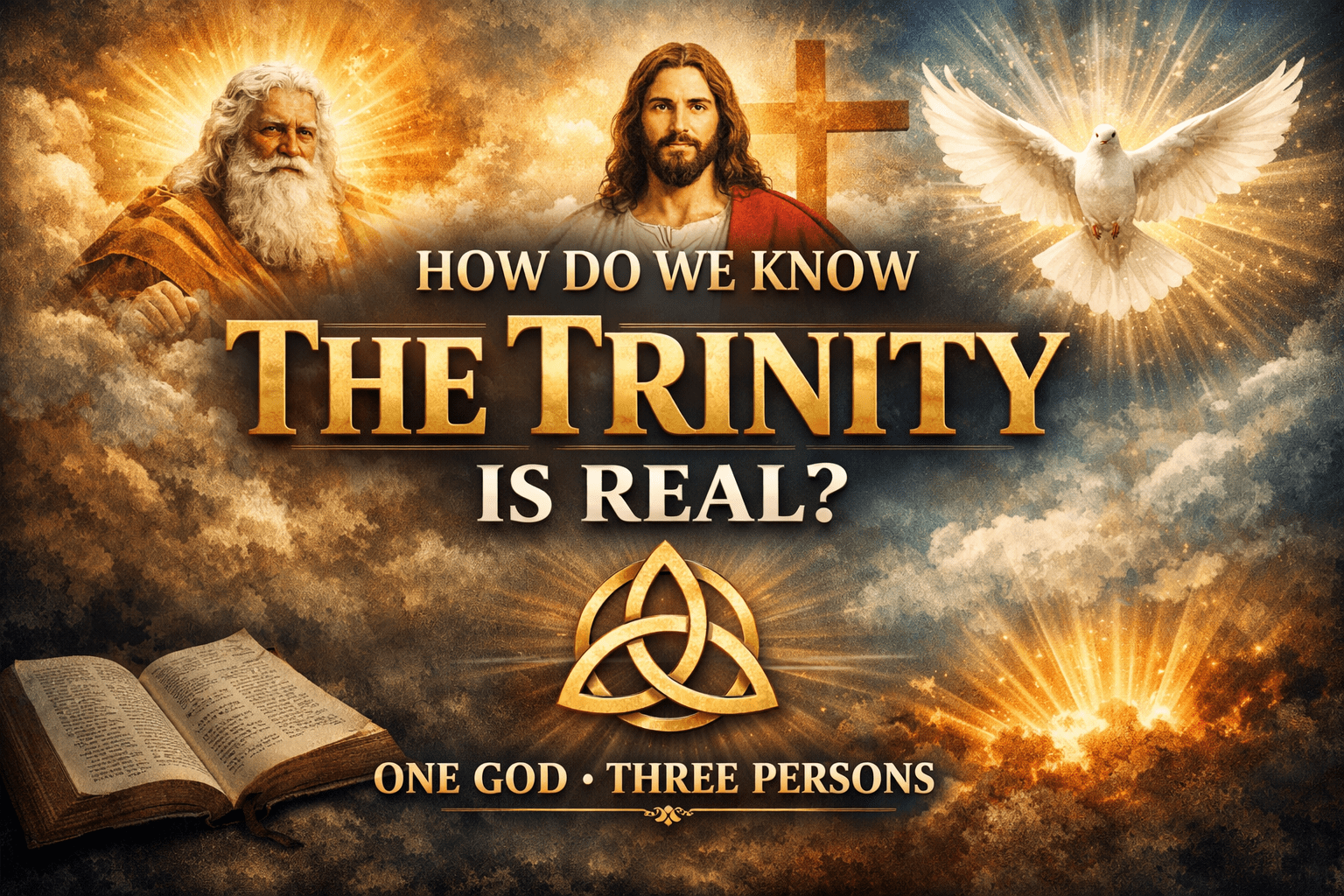
One God in Three Persons — Biblical, Historical, and Logical Foundations
The doctrine of the Trinity isn’t a philosophical add-on to Christianity. It’s the inevitable conclusion drawn from the totality of biblical revelation.
Christians didn’t invent the Trinity to solve a theological puzzle, they articulated it, because Scripture forced them to.
The claim is precise:
There is one God in being (ousia) who eternally exists as three distinct Persons (hupostasis) — the Father, the Son, and the Holy Spirit.
Not three gods.
Not one Person wearing three masks.
Not one supreme God and two lesser divine beings.
One divine essence. Three co-equal, co-eternal Persons.
Let’s walk carefully through how we know this.
1. Scripture Is Absolutely Clear: There Is Only One God
Christianity inherits Jewish monotheism.
The foundational confession of Israel in Deuteronomy 6:4 states:
“Hear, O Israel: The LORD our God, the LORD is one.”
The Hebrew word echad (אֶחָד) indicates unity — not isolation, but oneness of being.
The New Testament reaffirms this without hesitation:
• “There is no God but one.” (1 Corinthians 8:4)
• “God is one.” (Romans 3:30)
• “You believe that God is one; you do well.” (James 2:19)
Any doctrine of the Trinity must preserve strict monotheism… and it does.
2. The Father Is Fully God
This point is uncontested in Christian theology.
The Father is called God throughout Scripture (John 6:27, 1 Corinthians 8:6).
He is eternal, omnipotent, creator, and worthy of worship.
So we begin here:
There is one God, and the Father is God.
But the biblical data doesn’t just stop there.
3. The Son (Jesus Christ) Is Fully God
The New Testament explicitly and implicitly identifies Jesus as God.
Direct Statements
• John 1:1 — “In the beginning was the Word, and the Word was with God, and the Word was God.”
• John 20:28 — Thomas calls Jesus, “My Lord and my God.”
• Titus 2:13 — “Our great God and Savior Jesus Christ.”
• Colossians 2:9 — “In Him the whole fullness of deity dwells bodily.”
Jesus isn’t described as “godlike.” He possesses the fullness of deity.
Divine Attributes
Jesus is:
• Eternal (John 8:58 — “Before Abraham was, I AM”)
• Creator (John 1:3; Colossians 1:16)
• Omnipresent (Matthew 28:20)
• Forgiver of sins (Mark 2:5–7)
Divine Worship
• Jesus receives worship (Matthew 14:33).
• Angels refuse worship (Revelation 22:8–9).
• God commands angels to worship the Son (Hebrews 1:6).
If Jesus wasn’t truly God, this would be idolatry.
4. The Holy Spirit Is Fully God
The Holy Spirit isn’t an impersonal force.
Scripture describes Him with personal attributes:
• He speaks (Acts 13:2)
• He teaches (John 14:26)
• He can be grieved (Ephesians 4:30)
• He has a will (1 Corinthians 12:11)
More importantly, He is explicitly identified as God.
In Acts 5:3–4, Peter tells Ananias:
“You have lied to the Holy Spirit… You have not lied to man but to God.”
The parallel is unmistakable: lying to the Spirit is lying to God.
The Spirit is also:
• Eternal (Hebrews 9:14)
• Creator (Genesis 1:2)
So now we have a problem — but it’s a biblical problem:
The Father is God. The Son is God. The Holy Spirit is God. But, there is only one God.
The doctrine of the Trinity is the only framework that accounts for all four truths simultaneously.
5. The Persons Are Distinct — Not the Same Person
Christian orthodoxy rejects modalism (the idea that God is one Person appearing in three modes).
Scripture shows interaction between the Persons.
At Jesus’ Baptism (Matthew 3:16–17)
• The Son is baptized.
• The Spirit descends like a dove.
• The Father speaks from heaven.
All three are present simultaneously.
– Jesus prays to the Father (John 17).
– The Father sends the Son (John 3:16).
– The Son sends the Spirit (John 15:26).
These are real distinctions, not theatrical self-dialogue.
6. Early Christianity Affirmed This Immediately
The Trinity wasn’t invented at the Council of Nicaea in 325 AD. That council clarified language in response to Arianism, but belief in Christ’s full deity predates it by centuries.
The early Church Fathers:
• Ignatius of Antioch (107 AD) called Jesus “our God.”
• Justin Martyr described Father, Son, and Spirit in divine terms.
• Irenaeus of Lyons spoke of the Son and Spirit as the “two hands of God.”
They were articulating what the apostles taught, not innovating doctrine.
The council simply gave precision to what Christians already believed: the Son is “of the same essence” (homoousios) as the Father.
7. Is the Trinity Illogical?
Critics often say the Trinity violates logic…
It does not.
The Trinity doesn’t claim:
God is one Person and three Persons.
That would be a contradiction.
It claims:
God is one being and three Persons.
Being answers what something is.
Person answers who someone is.
You are one being and one person.
God is one being and three Persons.
Mysterious? Yes.
Contradictory? No.
Finite minds can’t exhaustively comprehend an infinite being. If God were small enough to fit neatly inside human categories, He would not be God.
8. The Trinity Is Necessary for the Gospel
The Trinity isn’t theological trivia. It’s foundational to salvation.
– If Jesus is not fully God, His atonement lacks infinite value.
– If the Spirit is not God, He can’t regenerate or indwell believers.
– If God is not tri-personal, then love isn’t eternally intrinsic to His nature.
Before creation, the Father loved the Son in the communion of the Spirit (John 17:24). God did not become loving when He made the world. Love has eternally existed within the Godhead.
9. The Trinity Is Implied Even in the Old Testament
Hints appear early:
• Genesis 1:26 — “Let Us make man in Our image.”
• Isaiah 48:16 — The Speaker (identified as the Lord) says the Lord God and His Spirit have sent Him.
• Psalm 110:1 — “The LORD says to my Lord…”
These aren’t full explanations, but they prepare the way.
The New Testament then unveils the fullness.
Why We Believe
We believe in the Trinity because:
- Scripture affirms one God.
- Scripture calls the Father God.
- Scripture calls the Son God.
- Scripture calls the Spirit God.
- Scripture distinguishes the Persons.
The doctrine isn’t a philosophical invention.
It’s the only coherent synthesis of biblical revelation.
One God.
Three Persons.
Co-equal. Co-eternal. Consubstantial.
– The Father is not the Son.
– The Son is not the Spirit.
– The Spirit is not the Father.
Yet each is fully and eternally the one true God.
And this triune God is the one who created you, redeemed you through Christ, and dwells in believers by His Spirit.
The Trinity isn’t merely something to defend.
It’s Someone to worship!
Discover more from Mathetes Mission
Subscribe to get the latest posts sent to your email.

 Mathetes Mission