

Very few questions spark as much curiosity as this one.
Most pictures you’ve seen probably show Jesus looking fair-skinned with flowing hair.
Films cast Him tall, radiant, almost glowing, and usually portray Him as formal and otherworldly.
But when we strip away centuries of art and imagination and ask a sharper question:
What does Scripture actually say about the physical appearance of Jesus of Nazareth?
The answer is quieter, humbler, and far more profound.
Today, we will walk through what the Bible says, what it deliberately does not say, and what history and archaeology can reasonably suggest, all while keeping our feet planted firmly in the text.

1. What the Bible Doesn’t Do
One of the most striking facts is this: the Gospels never give an exact physical description of Jesus.
That omission is likely not accidental.
In the ancient world, authors regularly described the physical traits of heroes, kings, and philosophers. Yet Matthew, Mark, Luke, and John (all eyewitnesses or close companions of eyewitnesses) leave us without height, eye color, build, or complexion.
Why?
Because the Bible consistently prioritizes who Jesus is over what He looks like.
“Even though we once regarded Christ according to the flesh, we regard him thus no longer.” (2 Corinthians 5:16)
From the start, Scripture resists turning Jesus into an object to be visually possessed or idolized.
2. Isaiah’s Prophecy: An Unassuming Appearance
The clearest biblical clue comes, not from the Gospels but, from prophecy:
“He had no form or majesty that we should look at him, and no beauty that we should desire him.” (Isaiah 53:2)
This does not mean Jesus was unattractive or deformed…
It means He didn’t possess the kind of outward splendor that draws attention or commands admiration by appearance alone.
In other words, Jesus did not look like a king.
This fits perfectly with the Gospel narrative:
- He blends into crowds (Luke 4:30)
- Judas must identify Him with a kiss (Matthew 26:48)
- The Roman soldiers can’t recognize Him without help
Nothing about His appearance set Him apart.

3. A First-Century Jewish Man from Galilee
Jesus was born into a Jewish family, raised in Nazareth, and lived in Roman-occupied Judea.
That anchors Him ethnically, culturally, and geographically.
Based on Scripture alone, we can say with confidence:
– Jesus was Semitic, not European
– He dressed like other Jewish men of His time (John 19:23–24)
To imagine Jesus as Northern European is historically impossible and biblically indefensible.
4. Hair, Beard, and Clothing
While Scripture doesn’t describe Jesus’ face, it does give indirect clues about His Jewish male appearance:
Beard: Jewish men typically wore beards (Leviticus 19:27). Isaiah 50:6 prophetically speaks of the Servant’s beard being pulled, implying Jesus had one.
Hair: Likely kept relatively short or shoulder-length, not flowing like Renaissance paintings. Paul notes long hair on men as culturally shameful (1 Corinthians 11:14), written within the same cultural world.
Clothing: Simple, functional garments. His seamless tunic was valuable enough for soldiers to cast lots for it (John 19:23–24), suggesting quality but not luxury.
Jesus looked like a working man… because He was.
5. Physical Build: Strength, Not Fragility
Jesus worked as a carpenter (Matthew 13:55), a craftsman, likely involving stonework as well as wood.
This was physically demanding labor.
He:
– Walked long distances
– Slept outdoors
– Fasted for 40 days
– Endured whipping and crucifixion
The biblical Jesus was not frail or delicate.
He had the strength of a laborer, conditioned by years of physical work and travel.

6. The Transfiguration: Glory Revealed, Not Permanent
At the Transfiguration, Jesus’ appearance changes dramatically:
“His face shone like the sun, and his clothes became white as light.” (Matthew 17:2)
The disciples did not follow Jesus because He always looked radiant.
They followed Him because they recognized authority, truth, and divine identity beneath ordinary flesh.
7. Why Scripture Leaves the Question Open
The absence of a description protects the Church from two dangers:
Idolatry – Fixating on an image rather than obedience
Exclusivity – Confusing cultural likeness with divine favor
Jesus can be faithfully depicted in many cultures because no single image claims biblical authority.
The real scandal of the incarnation is not what Jesus looked like… but that God took on flesh at all.
8. The Theological Point We Must Not Miss
Scripture is clear on one thing:
“We walk by faith, not by sight.” (2 Corinthians 5:7)
The New Testament never invites us to imagine Jesus’ face.
It invites us to follow His Words.
And one day, according to Scripture, we will see Him—not as a painting or picture, but as He is.
“We shall see him as he is.” (1 John 3:2)
Based on Scripture, Jesus was:
• An ordinary-looking first-century Jewish man
• Without striking beauty or royal appearance
• Physically strong, weathered, and familiar
• Indistinguishable in a crowd
And that’s precisely the point.
The glory of Christ was never in His appearance, but in His obedience, His authority, His sacrifice, and His resurrection.
Extra-Biblical and Historical References
– Josephus, Antiquities of the Jews (1st century)
– Tacitus, Annals 15.44
– Archaeological reconstructions of 1st-century Galilean Jewish men (e.g., Israel Antiquities Authority)
– Richard Bauckham, Jesus and the Eyewitnesses
– Craig Keener, The Historical Jesus of the Gospels
– N.T. Wright, Jesus and the Victory of God
Based on Scripture, geography, and some speculative generation; below is the leading ‘most closest resembling’ actual image of what Jesus might’ve looked like.
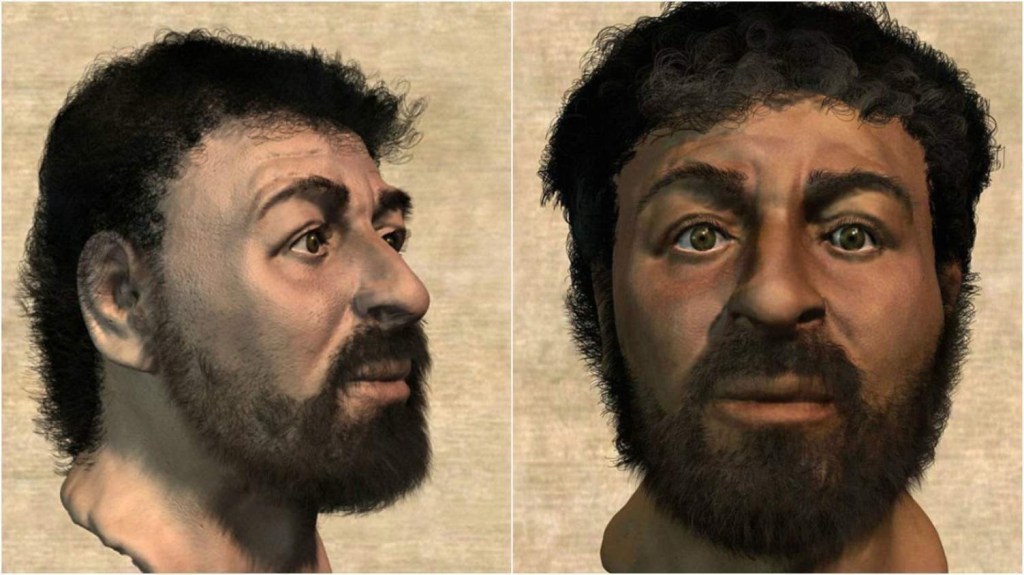
In a world obsessed with image, Scripture gives us something better than a face—it gives us the truth.
Discover more from Mathetes Mission
Subscribe to get the latest posts sent to your email.

 Mathetes Mission