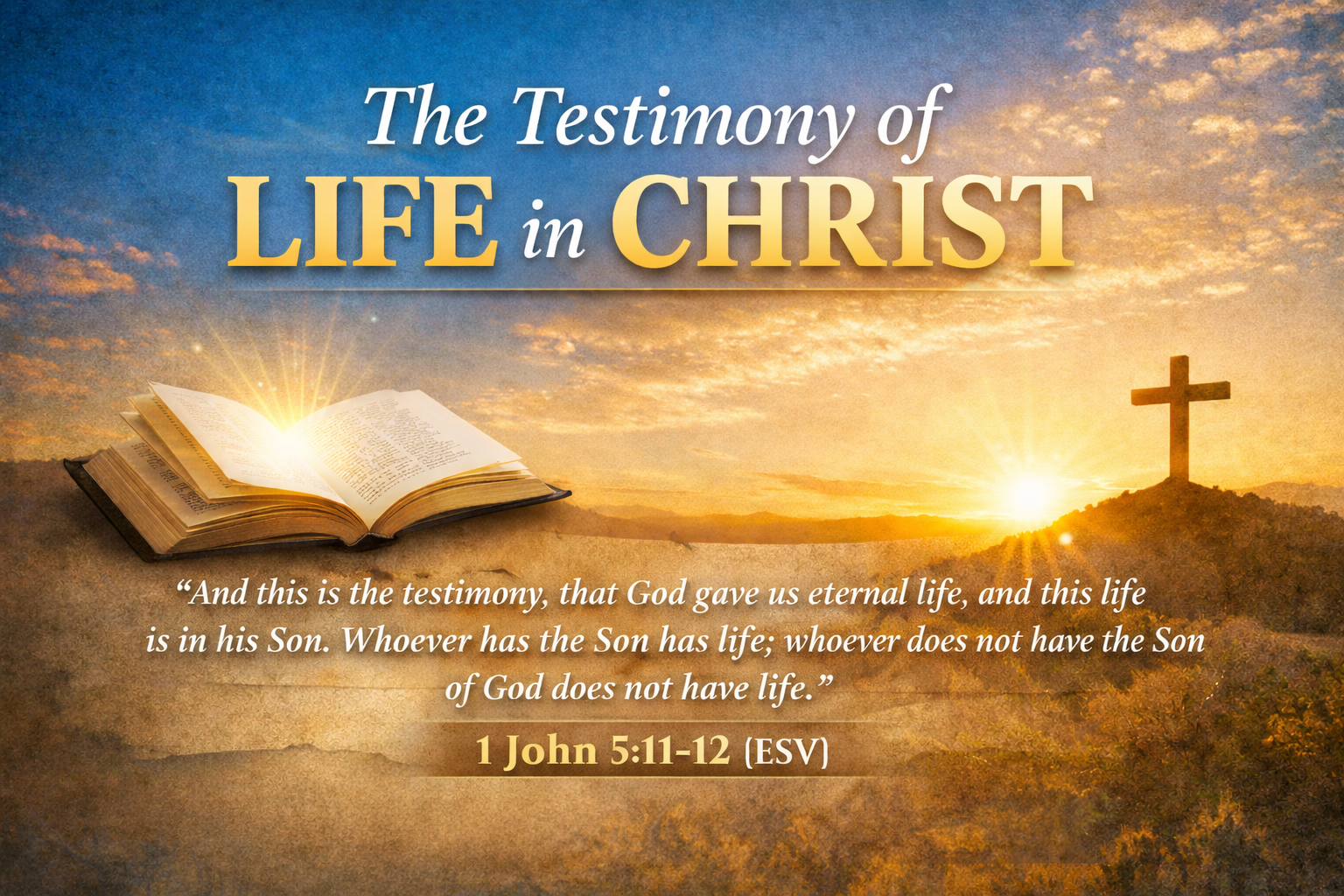
“And this is the testimony, that God gave us eternal life, and this life is in his Son. Whoever has the Son has life; whoever does not have the Son of God does not have life.” — 1 John 5:11–12
John basically compresses the entire point of the gospel into two sentences.
Eternal life is not presented as a future abstraction or a moral achievement, but as a present gift located in a Person.
The dividing line is stark and unapologetic: having the Son versus not having the Son.
This is not poetic exaggeration.
John calls this truth a testimony. A sworn declaration grounded in God’s own witness.
Context
First John was written to provide assurance to believers and clarity against false teachings (especially early forms of Gnosticism).
In the surrounding verses (1 John 5:6–10), John emphasizes that God Himself has testified about His Son. Verses 11–12 summarize what that testimony actually is.
Key Koine Greek Insights
• “Testimony” (μαρτυρία, martyria)
This term refers to legal witness or sworn evidence.
John is not offering personal opinion or philosophical reflection, he is asserting God’s own authoritative declaration.
• “Gave” (ἔδωκεν, edōken)
Pointing to a completed, decisive act.
Eternal life is not something God offers conditionally or doles out gradually, it is something He has already given.
• “Eternal life” (ζωὴν αἰώνιον, zōēn aiōnion)
This is not merely an unending duration, but a quality of life. God’s own eternal life shared with believers.
Eternal life begins now, not just after death.
• “Has” (ἔχει, echei)
Present active indicative. The one who has the Son currently possesses life.
Assurance is rooted in relationship, not future performance or works.
• “In His Son” (ἐν τῷ Υἱῷ αὐτοῦ, en tō Huiō autou)
The preposition “in” points to location.
Life is not found in doctrines alone, rituals, or moral reform… it is found in union with Christ.
John allows no middle category. There is no third option such as “partial life,” “potential life,” or “eventual life.”
Spiritual life is binary because it is Christocentric:
• Union with Christ = Life
• Separation from Christ = Death
This verse dismantles both moralism (“I earn life by good works”) and relativism (“There are many paths to life”)
Applying it
1 John 5:11–12 forces every reader to confront the foundation of their assurance.
Assurance: If eternal life depends on possessing the Son, then assurance rests on Christ’s faithfulness, not your emotional consistency or spiritual performance. Which is a great thing since we know Christ is perfect, and that we would fall short on our own.
Identity: Your life is not defined by circumstances, success, or failure, but by your relationship in Christ.
Evangelism: This passage gives clarity and urgency. The gospel is not primarily an invitation to improve behavior, but a call to receive Christ.
Daily Living: If eternal life is already yours, obedience flows from gratitude, not fear. Holiness becomes response, not requirement for acceptance.
Ask yourself: Am I trying to access eternal life through something other than Christ, like knowledge, discipline, good works or feelings?
Take a moment to respond honestly
Thank Him for the gift of life that is found in His Son.
Confess any areas where you have been seeking assurance apart from Christ.
Ask the Holy Spirit to deepen your confidence in Jesus rather than in yourself.
Then Reflect
1. According to this passage, how does John define eternal life, and how does that challenge common cultural or religious assumptions?
2. What practical difference does it make in your daily walk to know that eternal life is a present possession rather than a future uncertainty?
Key Truth to Remember:
Eternal life is not a reward at the end of a faithful life. It is a gift received through faith in the Son of God.
“Whoever has the Son has life.”
Study the Bible Deeper
• If you’re serious about growing in your understanding of Scripture, I highly encourage you to try Logos Bible Software—you can start with a free trial and see how it transforms your study time. — FREE TRIAL
• And for solid, biblically sound books and resources, take a look at ChristianBook.com—a great place to build your library. — CLICK HERE
Discover more from Mathetes Mission
Subscribe to get the latest posts sent to your email.

 Mathetes Mission