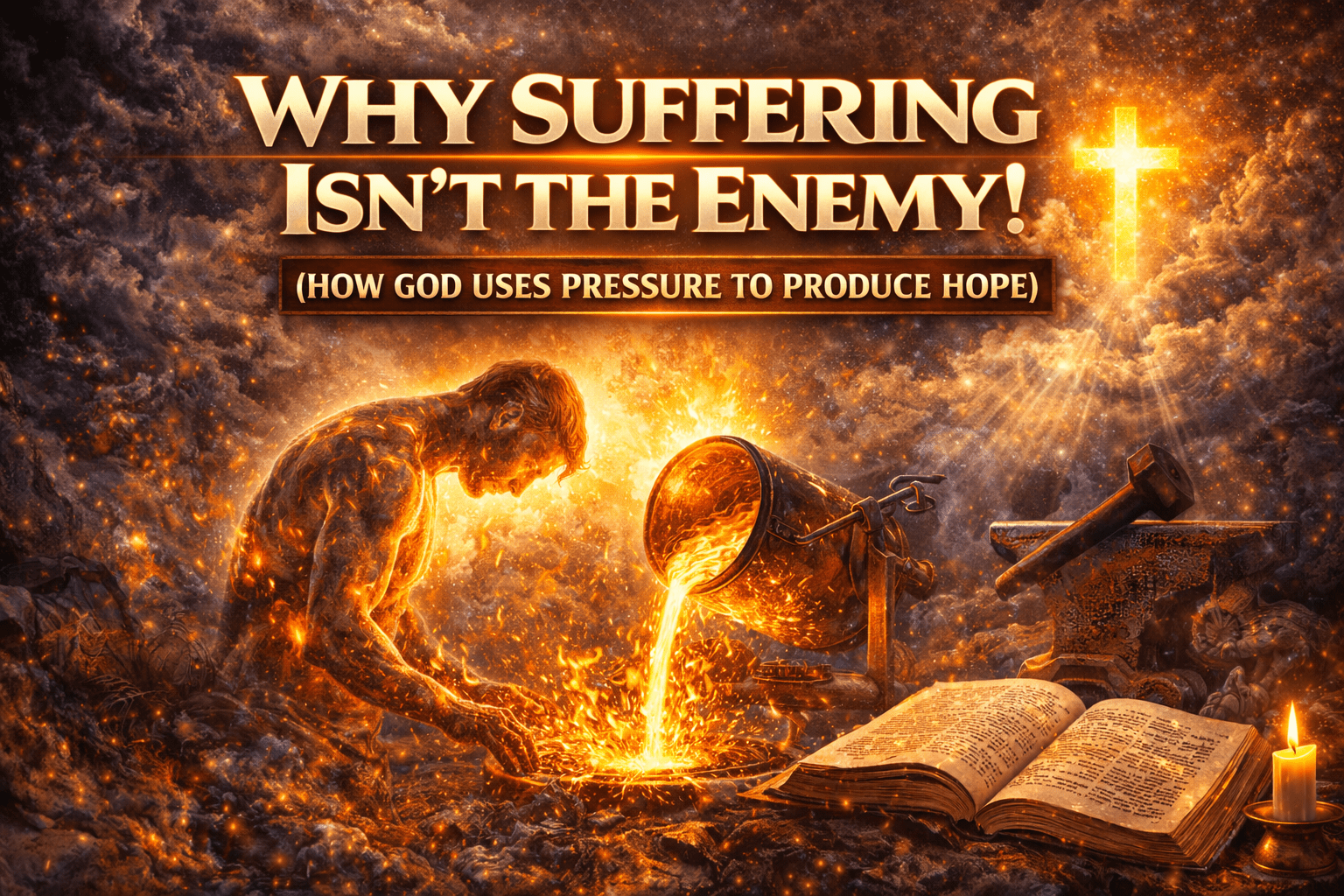
3 Not only that, but we rejoice in our sufferings, knowing that suffering produces endurance, 4 and endurance produces character, and character produces hope, 5 and hope does not put us to shame, because God’s love has been poured into our hearts through the Holy Spirit who has been given to us. 6 For while we were still weak, at the right time Christ died for the ungodly. (Romans 5:3–6, ESV)
There are few passages in Scripture that sound more backwards to modern ears than this one.
To begin:
“We rejoice in our sufferings…”
Most of us don’t rejoice in suffering… we pray for it to end.
We avoid it, numb it, explain it away, or assume something has gone wrong.
But Paul insists that suffering is not evidence of God’s absence. In many cases, it’s the very place God is working most deeply.
Let’s slow down and see why.
1. “We Rejoice in Our Sufferings”
Paul isn’t romanticizing pain. He’s realistic.
He uses the word θλῖψις (thlipsis), which literally means anguish, tribulation, affliction.
Think of Joseph in Genesis.
– Sold by his brothers.
– Falsely accused.
– Forgotten in prison.
Nothing about Joseph’s story feels joyful in the moment.
Yet later he can say:
“You meant evil against me, but God meant it for good.” (Genesis 50:20)
And Paul wasn’t saying suffering is good. He’s saying God is good in suffering.

2. Pressure Produces Perseverance
“…knowing that suffering produces endurance…”
The word ὑπομονή (hypomonē) means steadfastness under weight.
Not escape… Not avoidance…
Staying faithful when the weight doesn’t lift.
Think of Job!
Job loses everything:
– health
– family
– security
And still refuses to curse God.
He doesn’t understand what’s happening, or why, but he stays faithful.
That’s hypomonē.
God often builds our endurance, not by removing the load, but by strengthening us through carrying the heavy loads.
3. Perseverance Shapes Character
“…and endurance produces character…”
The Greek word here is δοκιμή (dokimē), which refers to something tested and proven genuine, kind of like metal refined by fire.
Peter knows this well.
He swears loyalty to Jesus… and then denies Him three times.
But after failure, repentance, and restoration, Peter becomes steady, bold, and faithful.
The Peter of Acts is not like the Peter of the Gospels.
Suffering, failure, and grace forge depth that comfort never does.

4. Character Leads to Hope That Doesn’t Collapse
“…and character produces hope, and hope does not put us to shame…”
Biblical hope is not wishful thinking. It’s confidence anchored in God’s faithfulness.
Think of Abraham,
He waits decades for God’s promise.
His body weakens.
Time runs out.
Yet he faith (not in circumstances) but in God, who keeps His word.
That kind of faith doesn’t collapse when life does.
5. Why This Hope Is Secure
“…because God’s love has been poured into our hearts through the Holy Spirit…”
Paul grounds everything in love, not just feeling the emotion, but acknowledging the divine action.
Then he goes even further:
“For while we were still weak… Christ died for the ungodly.”
Our hope isn’t based on how strong we are in suffering, but on what Christ has already done.
The cross is God’s final word on suffering:
• God enters it
• God redeems it
• God defeats it
Romans 5 doesn’t promise a pain-free life.
It promises a purpose-filled one.
Suffering becomes the soil where endurance grows.
Endurance shapes who we become.
Character anchors real hope.
And hope rests on a love proven at the cross.
God is not wasting your pain.
He is forming something in you that comfort never could.
He who did not spare his own Son but gave him up for us all, how will he not also with him graciously give us all things? (Romans 8:32)
Study the Bible Deeper
• If you’re serious about growing in your understanding of Scripture, I highly encourage you to try Logos Bible Software—you can start with a free trial and see how it transforms your study time. — FREE TRIAL
• And for solid, biblically sound books and resources, take a look at ChristianBook.com—a great place to build your library. — CLICK HERE
Discover more from Mathetes Mission
Subscribe to get the latest posts sent to your email.

 Mathetes Mission